
HELP promotional photo by Steve Double (courtesy of War Child)
Come Together: The Story Behind War Child’s Original “HELP” Album
Celebrating the Greatest Charity Album of the 1990s
Mar 05, 2026 Issue #72 - The ‘90s Issue with The Cardigans and Thurston Moore
The war in Bosnia had been raging on for four years when news of the Srebrenica massacre broke in July 1995. By then, 250,000 people had lost their lives and two million more had been displaced. But the long drawn out conflict had rendered most desensitized or apathetic. The systematic planning, scale, and sheer brutality at the heart of the Srebrenica massacre however, was a shock to the system for many. More than 7,000 Bosniak (Bosnian Muslim) men and boys were taken from a designated United Nations safe zone guarded by a Dutch peacekeeping force. They were separated from their families and told that they were safe by Serbian soldiers as they were herded onto buses and taken to a site where they were executed en masse. Their bodies were then dumped into mass graves and bulldozed over so as not to leave any evidence.
These reports would spur Tony Crean to create The HELP Album (mainly simply known as HELP), a charity compilation that would be released barely three months later. It featured 20 songs recorded in the same 24 hour period by some of the biggest ’90s British bands such as Oasis, Blur, Radiohead, Manic Street Preachers, and more. HELP exceeded everyone’s expectations, raising £1.25 million for the then new charity War Child.
A respected music executive and head of International at London record label, Go! Discs (Billy Bragg, Portishead, and Paul Weller), Crean was struck by a severe flu that summer and found himself holed up in bed with nothing to do but watch the television.
The reports of ethnic cleansing and violent images of the Srebrenica massacre, which the International Criminal Tribune later deemed a genocide, woke Crean up. “I found myself quite shocked to see both what was going on, just how bad things had got in Bosnia and the former Yugoslavia, and how little I really knew about it,” he explained on HELP: The Story of the War Child Album, a podcast that War Child commissioned in 2020 to commemorate the album’s 25th anniversary and reissue.
Due to the complicated geopolitics that came with the fall of the former Yugoslavia, NATO and most other countries had largely stayed out of the conflict. In 1993, War Child was founded by filmmakers David Wilson and Bill Leeson precisely because they were frustrated with the lack of effort from the UK government. They had witnessed the violence of the Bosnian conflict while on assignment there. Upon their return, they focused on how to help the children caught up in the conflict. It was Brian Eno, whose studio was in the same building as the War Child office, that put Crean on to the charity. Eno later mixed and mastered HELP.
For the average person, it was difficult to understand the sectarian violence in Bosnia. You had to delve beyond the headlines. But the front pages at the time were more interested in a different kind of battle, a chart battle between two Britpop titans. Crean recognized the irony that a violent war was being fought two hours away while the papers were expending column inches on Blur versus Oasis.
When Crean returned to work he wasted no time rallying his colleagues and friends about what they could do to help raise funds quickly for the kids in Bosnia. After all, between them, they knew, managed, or handled the PR for the biggest bands in Britain at the time. Masterfully, they set about getting Blur and Oasis signed on to the project.

24-Hour Blitz
An experienced PR man, Crean ensured the music press, tabloids, and television had access to the bands and artists as the album was being recorded. Film crews were dispatched to studios all across the country for one-off music videos during the 24-hour period which were then compiled for a Channel 4 documentary broadcasted two days after the album was available in stores.
“There were NME covers, Melody Maker covers, videos being made,” recalls Simon “Sice” Rowbottom, the lead singer of The Boo Radleys, whose contemplative track “Oh Brother” was second on the album and believed to be Eno’s favorite track. In 1995, The Boo Radleys had a number one album, Wake Up, and a hit “Wake Up Boo!” Rowbottom adds: “We were in the studio and it would be like, ‘Who’s coming? And oh, Noel Gallagher’s flying back from Australia, he might make it for this cover’…it was all really exciting.”
All the songs were recorded on a Monday in studios across Europe. In a time when there was no internet file sharing, each tape had to be physically sent by road, boat, or plane to Eno’s studios in London to be mixed and mastered the next day. On day three, John Squire of The Stone Roses completed the album artwork, aided by Robert Del Naja (aka 3D of Massive Attack), another feat in a time when most artwork was not done digitally.
On day four, all the artwork and mastered recordings were sent to processing plants around Europe and by day five, CDs were being pressed and cassettes made. The project was done with such speed that the tracklisting wasn’t available to print with the rest of the album but nothing escaped the precision and planning of Crean’s team who organized for NME to print the tracklist so that music fans could cut it out and put it in the back of the CD packaging themselves.
Noel Gallagher from Oasis had asked Johnny Depp to play guitar on the opening track “Fade Away.” Depp was at that time dating supermodel Kate Moss and together they were one of most feted celebrity couples of the era and rarely gave interviews. Moss was briefly featured on “Fade Away.” On September 4, the morning after recording the track, the couple not only made themselves available for a popular British breakfast show to talk about HELP and War Child but, impressively, Moss even got her supermodel friends involved in their cause.
Britain woke up that day to Depp in bed with five supermodels wearing T-shirts with “HELP” emblazoned on it. All of this PR blitz meant that by Saturday when HELP was available in the shops, eager fans rushed out to buy the album, helping make it to the top of the charts.
The Best of British
Charity albums at the time could have a fusty reputation and bands would often offer lesser singles or old B-sides to these endeavors. So Crean requested that the songs be originals or a new recording of a cover that would have to be recorded in the same day.
For this generation of musicians, memories of Live Aid, the huge 1985 rock spectacle mounted by Bob Geldof and Midge Ure, still loomed large in their minds. The multi-venue concert that took place in London and Philadelphia featured rock icons from Freddie Mercury and Queen, to David Bowie, Elton John, Madonna, Tina Turner, Phil Collins, and many others. Collectively, it succeeded in raising 127 million pounds for famine relief in Ethiopia, an astounding achievement at the time.
Bands also got involved in HELP as they understood how close to home the conflict was. Not since the Second World War had a war broken out in cities that Brits might have otherwise spent their summer or ski holidays in.
“Our sound man was actually in Yugoslavia with Babes in Toyland when the civil war started to happen,” explains Rowbottom. “It was very, very frightening for him to get out. He saw firsthand what was starting to happen so we’d had that kind of firsthand reportage.”
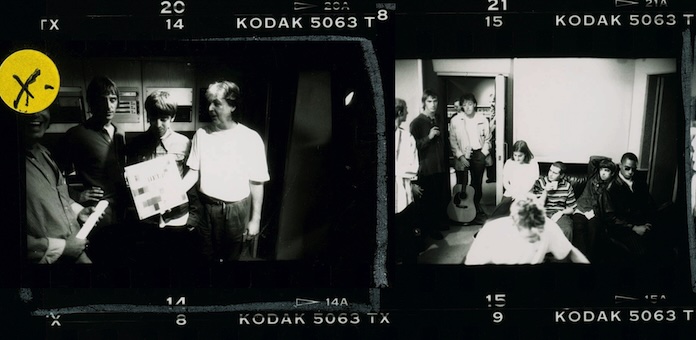
The speed of which to write, record, and produce an album didn’t faze artists. In fact, it galvanized them. Some even created bands just for the project: Noel Gallagher took the opportunity to gather his two musical heroes Paul Weller and Paul McCartney for his own supergroup, The Smokin’ Mojo Filters, who covered The Beatles’ hit “Come Together.”
One of five women featured on the album, Marijne van der Vlugt, a model, MTV presenter, and singer of the band Salad, whose debut album, Drink Me, was also released in 1995, was invited by her musical hero—Terry Hall of The Specials—to sing a duet of “Dream a Little Dream of Me” with him. The song was originally written in 1931, but is best known for The Mamas & the Papas’ 1968 version. On the day they recorded, Van der Vlugt recalls the excitement, energy, and nerves. “There was a four-piece string quartet in the studio and because Terry was one of the bigger names there was a film crew…and there were journalists, dogs, babies! And the producer Stephen Street, my boyfriend was there, and a journalist who I happened to go to school with…all at Metropolis Studio, which is a really famous studio in Chiswick [in West London].”
She adds: “It was the absolute mega center of indie music going mainstream. But it was also the Bosnian war which was why we were there…you had to put your ego, fear, and insecurities aside. We only had a small amount of time to get it down. I remember Stephen Street asking me to make up some harmonies on the spot and it felt like the whole world was watching…I remember suggesting a harmony to Terry and he went, ‘Hmmm, yeah,’” she laughs. “He did not want to be told by me how to do a harmony like Mama Cassidy.”
Hall died in 2022 from pancreatic cancer. “It was an amazing experience and the highlight of our career,” Van der Vlugt says. “To have an icon like Terry be a fan…was out of this world. I mean, I grew up on The Specials…it was a very, very proud moment. And I can’t believe that we’re still talking about it and HELP is still raising money for War Child today. That’s wonderful!”
Manic Street Preachers also recorded a cover, of Burt Bacharach and Hal David’s “Raindrops Keep Fallin’ on My Head”—a song that singer James Dean Bradfield would do at sound checks at the time. Massive Attack‘s contribution, “Fake The Aroma,” was an alternative version of their hit single “Karmacoma.” While Suede did a haunting cover of Elvis Costello’s “Shipbuilding,” a song about the 1982 Falkland’s War. The Stones Roses did a re-recording of their song “Love Spreads,” which was notable for being the only studio recording by the band that features drummer Robbie Maddix and keyboard player Nigel Ippinson (the band broke up a month later).
Other bands such as Orbital, The Boo Radleys, and Stereo MCs took it as a welcome challenge to write new songs given the constraints, with Blur also contributing a fun instrumental track, “Eine Kleine Lift Musik.” While all the bands involved worked hard to give something meaningful to HELP, Radiohead gifted “Lucky,” a brand new song and one of their best. It would be the first taste of their game-changing, art-rock opus OK Computer, released two years later.
The immediacy of this project was important for The Boo Radleys. “You could write a song and it could be two, three years before it’s out in the public consciousness,” recalls Rowbottom. And while it was a race against the clock, the unfinished song that guitarist Martin Carr had brought in worked well. “It didn’t need a huge amount,” explains Rowbottom, “so we were lucky in that respect. I think we even had time to shoot the video and go to the pub to do some press.”
_2.jpg)
Stereo MCs were in a bit of a funk in 1995. Their 1992 album Connected was incredibly successful, rendering four hit singles. “Around ’95, we’d been touring a great deal after Connected,” explains frontman Rob Birch. “And then when we came home, what we should have done was take three or four months off…but we didn’t. We went straight back in the studio. And I think we just didn’t really have the energy to be very creative.” He continues, “We worked really hard, long hours in the studio trying to grind out new material. But it just wasn’t really happening for us. And we did that for a long time. We tried moving studios…and people kind of say, ‘Oh, you took years off,’ but we didn’t actually.” They had in fact started a label and did remixes but “creatively,” explains Birch, “it was very hit and miss for us at that point.”
So the idea for HELP was a refreshing antidote for them that yielded “Sweetest Truth (Show No Fear),” one of the album’s standout cuts, reflective of one strain of the ’90s British sound that leaned into rap sampling whilst thematically speaking directly to the charity’s efforts. “It had a real sense of purpose about it,” says Birch, “I think it was such a mysterious sort of idea that it almost took the weight off your shoulders.”
_for_HELP_(Courtesy_of_War_Child)_1_close_up.jpg)
It took them out of a creative trough and also put perspective on their own struggles. “It gave you a moment to think about why you were doing it,” Birch continues. “We’re just not firing on all four cylinders right now but in terms of what’s going on in the rest of the world, this isn’t a big deal. And we can lend our skills to doing something which might help people who were really going through a hard time, especially the youngsters.”
Legacy
As a result of the funds raised, HELP made a genuine difference to the lives of children. It went immediately to providing food, shelter, and medicine for children on both sides of the conflict—from a mobile bakery to a dispensary for young diabetics and later a music center in Mostar, Bosnia where for the first time, a charity would see to the psychological well being of children by providing therapy.
It was also incredibly effective at forcing the political class and the public to focus on Bosnia. Then British Prime Minister Tony Blair even celebrated the album at the Q Awards that November. “This is a remarkable album,” he said. “At a time when there was a danger of the West turning its back on the war in Bosnia, it helped put it back in the headlines.”
Richard Clarke, the current Head of Records at War Child, concurs. “Certainly in the U.K., there was political apathy to act and one of the most remarkable legacies of that record is, it did stir action. Those musicians saying, ‘We’re going to do something,’ really forced it back onto the political agenda which is a remarkable feat,” he says.
“I think it’s a cultural artifact,” says Rowbottom, “very much of its time when there was a movement that people were coalescing around. There was no animosity between the bands…it felt easy to bring all these people together for a good cause.”
War Child has since released other charity compilations—1 Love (2002), Hope (2003), Help!: A Day in the Life (2005), and War Child Presents Heroes (2009)—but none have achieved a similar response or the kind of lasting cultural significance of HELP, considered by some the greatest charity album of all time.
“We’re never going to do that again,” explains Clarke, “because that was unique and special and incredible. It should be celebrated and not replicated.” But Clarke believes that there are other things that War Child can do especially since the need for War Child’s work is more acute than ever. As well as Ukraine and various other conflicts around the world, the children of Gaza are now suffering in the conflict between Israel and Hamas, a scale of which is unimaginable.
Irish band, Fontaines D.C. were quick to contribute to a Gaza benefit single together with Massive Attack and Young Fathers for the charity Doctors Without Borders. Fontaines D.C. had also previously done a live event in London for War Child. “We’ve always been involved in these kinds of charitable pursuits,” says frontman Grian Chatten. “We’ve done loads of stuff for homelessness in Ireland and we’ve put on gigs for that as well. But the idea of doing a record with other bands—I loved the whole kind of do everything in a day and just stick it out—yeah, I’ll be well into that.”
Heartened to hear of Chatten’s enthusiasm for HELP and War Child, Clarke jokes that he will get on the phone to the singer immediately. “There are a lot of artists like Grian Chatten from Fontaine’s who are politicized. They believe in social justice, change, and empowerment and they want to do good.”
Clarke adds, “Leave it with me, we’ll find that right project.”
Donate to War Child here: www.warchild.org.uk
[Note: This article originally appeared in Issue 72 of our print magazine, The ’90s Issue in 2024, which can be bought directly from us here. This is the article’s debut online.]
[Tomorrow, March 6, 2026, War Child are releasing HELP(2), a new star-studded charity album featuring Pulp, Arctic Monkeys, Wet Leg, Young Fathers, Depeche Mode, Olivia Rodrigo, The Last Dinner Party, Damon Albarn, Fontaines D.C., English Teacher, Beth Gibbons, Cameron Winter, Bat For Lashes, Beck, and many others.]
Subscribe to Under the Radar’s print magazine.
Support Under the Radar on Patreon.

Most Recent
- Watch Jerkcurb Perform “Help You” in a New Under the Radar Art Studio Video Session (News) —
- 500 to Go: Join Under the Radar’s Summer Subscription Campaign (News) —
- Premiere: Adjenai Shares New Single “Early Mourning” (News) —
- Joe Jackson @ Beacon Theatre, New York, US, July 18, 2026 (Review) —
- The Dink (Review) —

Comments
Submit your comment
There are no comments for this entry yet.