Daveed Diggs Wants Everyone to Be Okay
It could all end tomorrow
May 15, 2020
“It’s such a trickle, whatever it is,” says Daveed Diggs early in our conversation, struggling to accurately describe his career. “It could all disappear tomorrow.”
It’s an unusual statement from a creative polymath, particularly one as in-demand as Diggs has become since his defining duo roles as Marquis de Lafayette and Thomas Jefferson in the Broadway production of Hamilton. Since his Grammy and Tony anointed performance, he’s been fully booked. There’s been a stringing of guest spots, including Blackish, Unbreakable Kimmy Schmidt, and Bojack Horseman. An ever-developing music career with his Sub Pop-signed hip hop trio clipping. In 2018 he even pulled triple duty writing, staring, and producing alongside long-time friend and collaborator Rafael Casal in the indie film Blindspotting, a film that explored class tensions in his native Oakland, California. But despite his every-branching career trajectory, it’s being a rapper, and the scrappy early day ambitions that came with it, that Diggs still identifies with most. After all, could end any moment—better go all in.
“I don’t know why I still hold so fast to that, but I do,” he explains “To me for some reason, this encompasses all the things. I think it’s because the way I approach that is sort of the way I approach anything I do. In order for it to work I have to be really excited about it. It runs a lot on enthusiasm…. If you’re doing something, you’re going to put 100% into it, and you’re going to expect absolutely nothing in return, because that’s kind of the only way to ensure sustainability as an artist, is to not expect anything you come back from me, you have to really love doing the thing.”
The reasoning tracks. In conversation, Diggs even speaks like a rapper, his sinuous voice hopscotching from idea to idea as he verbally processes ideas, often thoughtfully doubling back to consider opposing viewpoints, a processing tick that’s often reflected in his body of nuanced work.
“Yeah, I like questions and I don’t love answers, necessarily,” he agrees. “Or I’m always suspicious of answers. When somebody tells me something’s a fact, I always want them to cite their source. My mom is the researcher, so that’s probably where this is coming from. I think good art asks more questions than it answers. And I think particularly art that deals with the human experience, when it’s done right, we are incredibly complicated beings.”
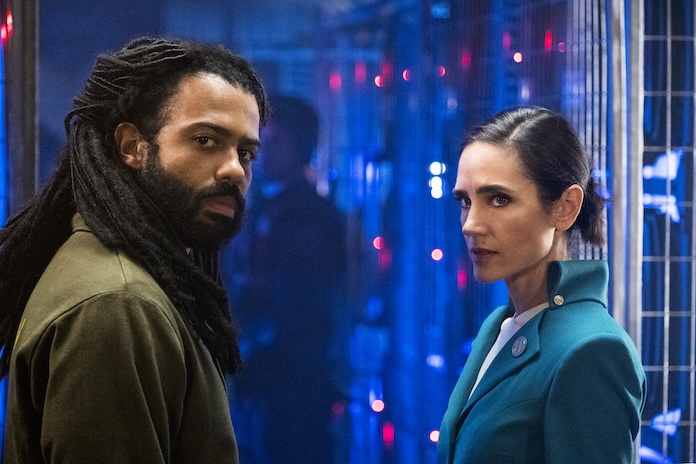
It was that tension that drew Diggs to his newest project, the TNT adaption of Snowpiercer. An adaption of both the 2013 Bong Joon-ho, and French graphic novel Le Transperceneige, (“I watched the film and read the graphic novels,” Diggs assures. “Did all my good nerd fandom duty.”) the series follows a train, 1001 cars long, circling the globe after the planet has been put into a deep freeze. Like terrestrial life, the transportation is divided by class, with the dark, cold end car reserved for the “Talies,” those who fought their way on at the last moment. Digg’s character Andre Layton is the defacto leader of that faction, determined to lead the rebellion that will allow his people to thrive. However, his efforts are opposed by Melanie Cavill (Jennifer Connelly), the train’s hospitality coordinator, who knows more than she’s letting on.
“I must have read the pilot four years ago,” Diggs recalls. “And it was asking a lot of questions we were all asking then too. I think part of the sort of genius of the conceit if it is that all of us are operating within a class structure that we don’t choose whether or not we participate in. We can ask some pretty, you know, pretty complicated questions, and then play around with them on the show.”
While displaying the characteristically cryptic nature of any actor wary of giving away plot points, Diggs promises that that by the end of the first season, and into the already-shot second season, the idealism in his character’s leadership will be chipped away, as he begins learning more about the true threats of their situation.
It’s a theme that runs through everything we discuss. Diggs genuinely wants to people to be okay—to the point having to repeatedly beat up a stuntman during a take left an emotional toll. (“It turns out I really do like, getting beat up more than I like beating people,” he says, a shrug implied in the words.) However, he’s a realist. He’s seen how fast having money can change the situation—and how unfair that can be.
“I think because my proximity to being broke is by pretty close right now, maybe I’m more attuned to it now than I will be in five years,” he muses. “But my life is so easy now. The hardest thing of my life is easier than almost anything I’ve ever had to do. Stuff is just done. And things are set up, even just the act of like, having a place to live that is essentially guaranteed. I bought a house, that’s a different thing. It’s just a different thing. And there are there are certain comforts that is, as you enter a level of comfort, you become really easy to take for granted. I think this moment forces us to highlight some of those things. I’m always optimistic. And I think we always are lumbering towards more equality. I think we don’t I think we generally always think we are further along than we are in that department.”
But even more than financial gain, Diggs has come to realize he’s come to have another powerful commodity—name recognition. And while he’s uninterested in expanding his personal empire, it has come in handy when working to elevate the work of his creative cohorts, most which have been collaborating with him for years.
“The thing that happened to me sort of post-Hamilton that is so significant is that if I have an idea somebody wants to hear it,” he says. “I have always been my community of artists, that always had lots of ideas but nobody cared. And now people will like at least want to take the meeting to see if what I’m thinking is profitable, which I think is the most significant change in my life. I’m sort of at capacity with what I am capable of doing. But I have a community of artists isn’t. So, I get to walk things into doors and call myself a producer now, which I’m still learning what that job actually entails. But I think, a big part of it is holding a door open a little bit longer so that somebody hyper-qualified can walk through it. And that’s what Lin [Manuel Miranda] and Tom [Kail] did for me. My turn to pay that forward for other people.”

Most Recent
- 500 to Go: Join Under the Radar’s Summer Subscription Campaign (News) —
- Lava La Rue Shares New Single “Prince Of Bologna” (News) —
- Premiere: The Blood Arm Share “World Class Traveler” (News) —
- It Was Just an Accident [4K UHD] (Review) —
- Beck Announces New Album, Shares Video for New Song “In the Night” (News) —

Comments
Submit your comment
There are no comments for this entry yet.