
Felsmann + Tiley on “Protomensch”
Dance Music to Ponder
Feb 19, 2026 Web Exclusive
If the desire to make a conceptual dance album that embraces the emotional weight of cinematic scores while still practising the minimalist principles of neo-classicism wasn’t ambitious enough, Protomensch (out now on Mute Records)—the second album from Felsmann + Tiley—also packs in a philosophical bent and social commentary.
That’s a lot of heavy lifting for a genre whose function is often to simply make us move our bodies. However, the album manifesto they posted on one of their social media feeds ahead of the album’s launch, is not unreasonable. “At its core, it’s about the paradox of the idiotic genius. We build cathedrals and algorithms, drop bombs and write lullabies. We’re capable of deep and industrial-scale cruelty. This idea shaped the way we made the album—and it existed long before we had a name for it or wrote a single note.”
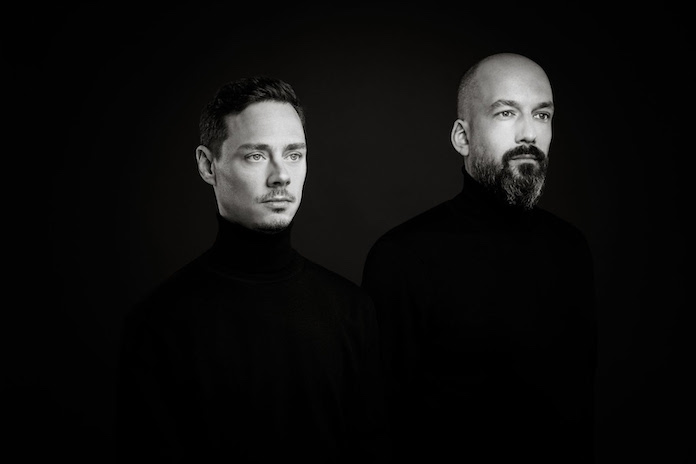
German producing duo, Dominik Felsmann and Patrick Tiley, have been making music together for 22 years. They’ve made a name for themselves with remixes of M83’s “Solitude” and more recently “The Most Beautiful Boy” by The Irrepressibles, which have both found their way to soundtracks for television. With Protomensch, meaning proto-human in English, an idea that came to them back in 2017, there was a want to break away from the pack and create music that gives pause and makes us ponder.
This they’ve done effectively with clear-eyed messaging using visual storytelling elements in songs like “Warum” and “Gabriel,” a bemusing track that engages listeners with a simple idea in their music video. “You put something out,” Felsmann explains, “and someone goes ‘I’ll spend more than the 0.3 milliseconds that it takes to scroll to the next reel with this music. To read the ‘Gabriel’ statement twice and think, ‘what does it actually mean?’ That’s beautiful.”
Tracks like “Open Fields”—featuring The Kite Street Tangle (Australian Danny Harley)—and “God is Lonelier”—featuring Laius (Chinese-Australian queer artist Evan Ho)—shine with a raw, emotional resonance against the duo’s backlit synth soundscapes. On the opposite end, “Opioid”—featuring London indie band Pet Deaths—is a pounding, punk-hearted track with pitched-down vocals that call to mind “STAR” from Underworld’s experimental 2019 album, Drift Series 1. The accompanying video directed by Tim Hunkemölle doesn’t mince the duo’s feelings about current societal addictions.
“Memory” is among the most evocative of the prettier-synth tracks while “Always You”—which features Woodes, the angelic vocals of Australian singer, Elle Graham—is beatific in its exaltation of love and hope.
Speaking via Zoom from Felsmann’s current home in Brisbane, Australia and Tiley’s in London, England, the pair discuss how they picked their guest collaborators, the album’s striking cover art of a dapper chimpanzee, and why they’re like an old married couple.
Celine Teo-Blockey (Under the Radar): It was only after I saw the video for “Warum” that suddenly, everything made sense to me. And the album’s cover of this chimp, all coiffed-up and this idea we can wear a turtleneck that says we’re super sophisticated, but we can’t lie about our true nature. In the end, we are just animals. And I wondered how many dance records are making grand statements like that?
Patrick Tiley: That’s great to hear. Thank you for taking the time to look into it.
Dominik Felsmann: We started the whole thing from the perspective of wanting to make something that’s our own. We come from the dance world. So we’ve played and DJ’ed and obviously that’s why we ended up in different parts of the world because we were touring a lot. But a lot of the music that we were making was very dominated by what the market or the scene or everyone else or A&Rs think. And we said, ‘Hey, we wanna make something that we really love. And where there’s a little bit less sort of need to comply with what anyone might think.’
And the second thing is we had this idea that, we are electronic artists but what we love about electronic music is the soundscape, the big melodies and sort of the impact you can create with it. At the same time, we love film scores and how dramatic they are, how expansive and the emotion scores deliver.
And we were just sort of like getting into the neo-classics, the sort of simplicity of those guys that just have these seemingly simple melodies, but they create beautiful moments with it. And we thought maybe we can do something in between? So the whole thing was a bit of a, first of all, rebellion against the scene. And second, it was sort of fusing all the things that we really love about music.
When you say the neo-classicists who are you referring to?
Felsmann: Like the, the usual suspects, like the Olafur’s, Nils Frahm, or even Einaudi, all these sorts of people that, I dunno, they just make beautiful music. There’s probably 50 more to mention, but I guess they’re like the most obvious candidates.
Tiley: And also our journey, we started out with sort of harder music, which is all en vogue again now, right? All this hard techno stuff has sort of come full circle, like we’re pretty much done the exact same stuff that’s trendy now, but in 2004. And then you know, like 10 years ago, we were sort of discovering all these other types of music, including neo-classical and started paying more attention to it. So at the time it was sort of like opposite land and it was all quite exciting and new. Like, “Oh wow, this Nils Frahm guy is selling out the Barbican.”
Can we can start with like the opening track. So “Open Fields” how did that collaboration with Danny Harley come about? It makes more sense to me now that I know you’re based in Australia.
Felsmann: Well, I went next door to Danny’s studio right here and we wrote a song together. [Laughs] So Danny and I have a music studio together. And we were sort of living next to each other, as work buddies for a few years now. His voice is very unique. When we started doing vocal tracks with this album and sort of the people that were picking, they all sort of had to fulfill the criteria of sounding interesting. Like the first two syllables of a song or the first like breath or something should draw you in. And I think he’s one of those few people where he’ll open your mouth and like, “Ah, this is interesting and this is different.”
And we wanted to do this for a long time but there was never the right song for it. And then when we started working on the album, it sort of became clear that we could probably try it out. It came about really easily. It was like a half day sort of thing. We just sat down and the first few things he was singing and mumbling were already feeling great. So we’re like, “Okay, this is good. This feels natural.” Whereas, you know, with a lot of other artists, you have to explain why this is the Felsmann and Tiley thing. And with him, he sort of feels the same melodies but still adds something to what we do. So I think that’s why we really loved having him on the song.
The texture of his voice is kind of mesmerizing. It really draws you in. How does that one kind of contrast with something like the “Opioid” song, which has a different feel altogether?
Tiley: Funnily enough, like the Pet Death guys, they can sing, right? So, we sent them a few potential demos, they’re like 30-second things. They sang over all of them and all of them were really nice songs, but they also added this “Opioid” thing to the package that they sent back to us. It was one of those songs where we are tapping back into the world that we originally come from, sort of rough stuff. It felt like heroin chic, catwalk music. And our music has been placed in fashion shows before. So we’re like, “We can do this without having to bend it too much.” And so it was like a big light bulb moment, this great idea that we want to follow through.
And you didn’t feel that it was clashing with anything?
Felsmann: The topic itself fits really well into the Protomensch manifesto? It’s like drugs are good, but drugs are also bad. Overconsumption is great, but also bad. Like you scrolling five hours on TikTok is fun, but also really bad. Opioid stands for the sort of the human thing of just getting addicted to anything around us. Be it work, be it drugs, be it social media, be it anything, right? So it had to be rough and it sort of fulfilled that part of the story we wanted to tell.
Tiley: And also an album ideally, isn’t just the same track 12 times. You need some mountains and valleys, a bit of contrast. That’s why you will find a few tracks that are on the opposite end of the spectrum on this album. Interestingly, also that “Opioid” track is still semi inspired by Boys Noize and Gesaffelstein, that period in 2010, 2011.
Let’s move on to “Gabriel.” Just the name made me think of the association with the Archangel Gabriel. When I first heard the track, it evoked the epic wide-screen feel of German cinema, like Wings of Desire. And then when I actually saw the video, that screen shrunk—I was like, “Oh the Angel Gabriel is in the midst of writing a tweet.” It was such an interesting concept. Immediately, my brain went into this thought experiment mode. And it says “The Virgin Mary is Pregnant,” and I noticed that the date was October 13th, 2025. That means that the birthday would not be Christmas Day.
Felsmann: Fair call. [Smiles]
Tiley: The experiment there is sort of playing with, you know, if Gabriel did actually show up today, who would actually believe him? That’s why there’s this core message: There’s now more messengers than messages. These days it’s difficult to know who can you trust? Who can you listen to, who should you listen to? Who do you need to ignore?
So good. I really enjoyed just kind sitting there, thinking “What is this?” It’s just a whole other level. Because so much of dance music can be just about dancing. So the track “Warnung,” what does that mean? And did I pronounce it right? And what language is that in?
Felsmann: It’s in German and it means “warning.”
Okay. Because it sounds like, I don’t know—
Felsmann: Indonesian.
Yes! Anyway, “warning” makes sense, especially if you also watch the video. It almost gives too much away. It’s like a disaster movie, but actually it’s just another day in Trump’s world at the moment. Tell me a bit about that track.
Felsmann: I think Pat needs to tell the story and I’ll tell you something about the music.
Tiley: It’s quite obvious what’s happening in that video, right. And we’re aware of all these things that are going wrong, and we listen to them every single day, but then we don’t really do anything about it. You know, we’re seeing the cliff and we put the foot down, accelerate, and are happy to just let whatever happen. And it’s sort of mind boggling how that can be.
Felsmann: I mean, the song itself has like this foghorn sort of sound in the beginning. We always love that sound in itself. And I think that’s the case with a lot of the songs on the album. Like if you hear it, you might be, “This is weird and this is like not doing a lot for me,” but when you combine it with the music video and the sort of messaging, all of a sudden that single sound gets a whole different sort of meaning. Having a foghorn and you’re a boat in the fog…and everyone’s like, “Better get outta the way, ‘cause I’m about to crash.” But no one does anything about it. So the whole intention of it, is that! You know, musically and from a storytelling perspective, and also the music video, it’s all there to make you think.
Tiley: It’s again, one of those duality concepts of humans, as geniuses and idiots right? And it’s like, “We love and we hate, we build things, we destroy them.” We just don’t seem to be capable of doing anything about it. This is just what we do.
I know, we can’t have nice things.
Felsmann: Which is weird.
Tiley: And stupid. But then we pull off things like inventing all this AI stuff, and at the same time, we shoot each other every single day somewhere on planet Earth.
It’s interesting trying to figure that out in a song. Expressing this in a way that you guys are doing in your craft must give you some sense of I don’t know, you’re doing something good with this bonkers moment that we’re in.
Felsmann: Let’s hope so.
Okay, so what does “Warum” mean? That must be German too.
It means “why?”
Nice. Listening to the track alone, there’s a kind of dabbing, sonic Pointillism to it. And when I saw the video, I thought, “Oh, that’s like a typewriter!” Or when you’re typing into your keyboards, that, I don’t know, I just, that’s just where my brain went.
Felsmann: Well, Pat bought a typewriter just for that.
Oh, okay! The funny thing is, some of the lines had this almost too perfect symmetry to it that it made me wonder, “Did you use AI for any of this?” You know how chatGPT and stuff, it’s always trying to be clever and make like rhymes or be very amenable. Anyway, that line “We figured out how to rush towards utopia and dystopia in the same timeline”—that made me wonder. I definitely get the irony that before the advent of LLMs, I would be like, “Such a well-crafted sentence that says so much.” And now I’m like, similar to when I see a beautiful ocean scene, “Did AI do that?”
Tiley: So obviously GPT ruined em-dashes for any and all writers… But that one, was actually, man crafted. [Laughs] It’s artisanal.
Like craft beer.
Tiley: Yes.
Felsmann: Maybe to add to that, Pat loves diving really deep into philosophic shit—excuse the French—but like the whole album and the concept is pretty old. I think there’s pages and pages of Pat musing over this topic. I think at some point it was called Opera Absurdity. We actually did come up with the concept and the idea, and that duality and paradoxical nature of what we’re making music about or wanting to talk about that. That’s happened over a few years in just like long phone calls and debates over that topic. It’s essentially the manifesto condensed for years into something that’s kind of funny but still has weight. I feel like you read it and you can laugh at it, but you know that it’s also serious.
Yeah, and it has a depth to it. And like these small observations, that we all recognize as true. I just had to laugh at, “We grow vegetables in our backyard to become precisely 1% self-sufficient,” because I’m like, “That’s my dream!”
Tiley: [Laughter] You know what, like same here. It’s sort of people, in the tech world, they always have this idea of, “I want to quit tech. I want to start a farm,” right? So, we’ve finally gotten an allotment somewhere and started growing some vegetables and half the stuff just dies. If you had to actually live off it, it’d be impossible! And then you spent more money on actually fertilizing everything and all the time you put into it, and it doesn’t really make a lot of sense. It’s a hobby at the end of the day, which is perfectly fine. Right. But you go into this with this, “Oh yeah, I could survive on my own.” No, you couldn’t!
I probably would have one of those bunkers where you have like all this canned fruit there. That’s probably the better way to survive the apocalypse, you know, rather than growing your own vegetables in the backyard. But it’s a human instinct, isn’t it?
Tiley: Yes, of course.
To be like, “I wanna do something. I wanna be good. I wanna make my food.” Because I can, and if we thought about all the bad things, it’s like we’d just be in a fetal position and never get out of bed. Or we might as well try and get a rocket to Mars with Elon and his friends and just go to another planet, conquer it, and start again, which is probably not far from what they’re thinking.
Felsmann: The thing is also that there’s a lot of Green movements and social movements, a lot of them feel like virtue signaling. Just because you plant fruit in your garden doesn’t mean that you’re super green, because you also fly around the world four times a year and you get a new phone every year when the new iPhone comes out. Like there’s sort of this thing where we find peace but also some sort of entitlement through those things. And we think we’re better than anyone else. But changing things is actually quite hard and it requires a lot of sacrifice. So I think that’s sort of the bit that we’re pointing out is that a lot of that stuff is really easy and it seems like you’re making a difference when in actual fact, it might not help the world. It’s a bit like the climate crisis or the food crisis—
Tiley: Like, Leonardo DiCaprio taking a private jet to tell you how important it is to save planet Earth.
I hear you.
Felsmann: Look at these two angry guys. [Laughs]
So with this song, how do you connect everything that you wanna try and put in this song, with the actual music and the message. And then at what point do you go, “We’re not going to sing all this stuff. We’re gonna put it in a video on YouTube so that people can read it!”
Felsmann: The music we make…a lot of it feels existential and big and epic, but at the same time you feel somewhat somber after it’s done. We always struggle to sort of explain a lot of the emotions in the songs that we make. It’s “weltschmerz”—that sort of feeling that we’re very connected to, I think probably as Germans, but also generally, in the sort of melancholy of the music that we make.
So for us, it was always very hard to explain what it makes us feel like. So, with this album, even with this song, it gets quite big, but it also leaves you feeling a bit weird and unsure. So it had that existential thing and the most existential thing is asking why. That’s why that song is the first one. Because technically it’s the first release, and one of the first questions you ask is, “Why am I here? What am I doing here?” And that song felt like that, in a way.
Tiley: And if you’re talking about the methods, so that first self-released album we did Tempora, which is just titles after each month. The task then was literally, “What does each month sound like?” So you’ve got that song, you’ve got the title, and now you’re trying to make some music that fits that. With Protomensch, it’s a sort of mix of both, like, “What could this idea sound like?” But then also you have a finished song and you don’t actually a hundred percent know yet what you’re trying to say or with what it feels like. And then you start thinking about it whilst listening back to it over weeks—you can go both ways essentially.
You’ve got three Australian acts on your album. I know what the connection is to the one right across the hall from you but I guess you must also be very connected to the music community here.
Felsmann: I think we kept the circle quite small for the album just because we wanted to have some sort of personal connection to the people. We did sessions with other people too but we just felt that a lot of the music lacked the connection that you have when you’re in the same room. And with us being, you know, we see each other a few times a year and then go to the studio. And we make music together on Zoom and everything.
But in a writing session, it’s often better to just be with the people. And sort of get into the same mood, which is why a lot of it has happened here. And Woodes and Evan are both, like…with the studio, we run a program together with APRA, here in Australia to sort of give free studio space and mentoring to underrepresented groups in music. And you know, music is technically all white males that dominate it. So we have this program where we just invite people that represent other other groups that make amazing music but that seem to find it hard to just get a foot in the door. So Evan’s one of them that we had here. And we loved his voice. He writes these really epic, dramatic songs with a depth to his lyrics…. And with “Woodes” we’re like, “Okay, what if we take the complete opposite and put a poppy voice on this?” And Elle, she’s got this sort of angelic, soothing voice and I’m like, “Ah, this is great too!”
Yes, that track sounds beautiful.
Felsmann: And her music’s cinematic and we’re like, “Oh, okay, she’ll get this thing.” We had a connection with her but we sort of wrote it over WhatsApp. She was in LA and here for some of it. She travels a lot. But at least there was that connection and this sort of mutual understanding of what this should sound like with these people. That was the main thing for us when we picked the collaborators and we had that connection with the Pet Deaths guy too. Like we had a call with them. We’re like, “Okay, these guys are funny.” The dude runs a bar and we instantly connected. So it was like, “We don’t have to overexplain this. They’ll just feel it and get it.”
I wanna just talk quickly about remixes. You guys have a reputation for them. Has there been something more recently that you’re like, “Oh, I see something in there that I’d like to flesh it out in a remix?”
Tiley: I feel like we listen to music every day and hear things that where we go, “We would do this differently.” I think, for us, generally remixes are there to elevate or sort of show a different perspective of something. We take one bit that you really love and just do your thing with it.
Felsmann: I think one thing we’ve been chatting a lot about is maybe trying rap because there’s a lot of interesting voices and often just spoken words with epic music in the background can be really cool. I think we’ve been pretty busy with the album, but as soon as we get our heads above the water again, that’s something where we’ll probably do a little bit of scouting and just trial some ideas.
You’ve worked together for 22 years, has the way you work changed?
Felsmann: I think the roles have always been the same. Pat is someone that just sees the big picture of something a lot more than I do. And he listens to music very differently than I do.
What do you mean?
Felsmann: He can hear an idea and visualize what the idea can be. And often, I’m someone that’s just a little bit more on the ground, fiddling around with stuff. And I do get lost or do get too attached to something. So we’ve always had that sort of relationship of those two roles. It’s just become less sort of—it’s still very combative, in a good way.
Tiley: In principle, we are sort of from the same town. Not quite, we had to hop on a train for 40 minutes. When we were 16, it was internet, phone calls, and then occasionally meeting up. Now it’s on two continents, but actually it’s still the same as it was in 2003.
If you could go back, can you remember one confrontation or idea that both of you were coming from different perspectives and who won in the end?
Felsmann: I think “Warum” was one of the songs where we had the sound and the sound was cool, but the song wasn’t there. And Patrick loved that sound. And I remember when we listened through our collection of ideas, he was always drawn to it and I just couldn’t see the vision for it. And then if he falls in love with something, it’d be like, “This is, this is gonna be a song, so let’s work on that.” Whereas, I would’ve probably said “it’s a cool sound” and just put it in the bin. To me that’s like one of those moments to realize it is good to have a collaborator.
It’s good to have someone that just listens to it with a different vision for things. And then you can see where it ends up. And, and we finished that song in the UK together in Pat’s office more or less. Because we just had all these new ideas and we tapped into sounds that we hadn’t used in 20 years where he was like, “Okay, now put this in there and that in there, and I remember this one from back in the days.” And I wouldn’t have come up with the song if it hadn’t been for him hearing something. [In terms of] the combativeness…there’s just a lot of yelling and convincing and debating involved. But it ends up with interesting music. Or do you wanna hear actual fights?
I’d love to be a fly on that wall.
Tiley: It’s very much like an old married couple where you’re like, “This is pretty much abusive,” but you still kind of like each other. Kind of. [Laughs]
Felsmann: I think that describes it well.
Subscribe to Under the Radar’s print magazine.
Support Under the Radar on Patreon.

Most Recent

Comments
Submit your comment
There are no comments for this entry yet.