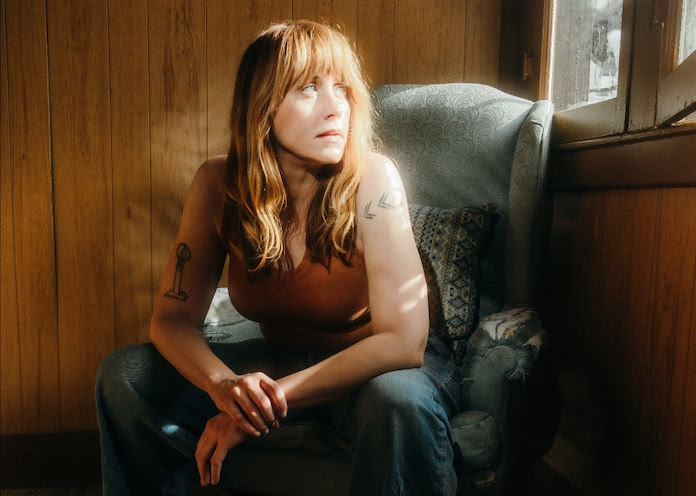
Flock of Dimes on “The Life You Save”
A Life’s Work
Nov 12, 2025 Web Exclusive Photography by Elizabeth Weinberg
Jenn Wasner has had her hands in a lot of pots. Aside from being one half of the duo Wye Oak, during Wasner’s formative musical years, she is a current member of Bon Iver. But her most personal work has been her solo project, Flock of Dimes. Head of Roses from 2021 was her last full-length album and it was a stunner. In part the album focused on the dissolution of a relationship, but unlike many breakup albums, Wasner was willing to turn the lens on herself. So it’s not a total surprise that Flock of Dimes’ new album, The Life You Save (on Sub Pop), is fully given over to a bottoms up self-assessment of Wasner’s role in relationships in her life. Whether that be from birth or with an eye to the future. But interestingly, Wasner didn’t intend to be the subject of her own album.
Talking via Zoom from her home in Pasadena, California, Wasner was an open book in talking about the inspirations that drove her latest work. In fact, the press kit for The Life You Save came with a 15-page document of lyrics and back story on each song. You will read later on that Wasner views the album in retrospect as something of a guidebook for herself. The album addresses her own role in codependent relationships. But many of the relationship issues tackled are universal. Looking back on our discussion, it’s clear to me now why I asked about certain songs: “Afraid,” “Instead of Calling,” and “Theo” all resonated directly with my own life experiences. And not surprisingly, the empathetic Wasner hopes that fans will take something personally helpful away from what she put down.
I’ve been a fan of Wasner’s work since shortly after I started writing about music, so it was a privilege to get to talk to her, which included tracing a bit back to her prior album and tour.

Mark Moody (Under the Radar): Last I checked in on what you were up to, you were doing house show type performances?
Jenn Wasner: Yeah, I’ve been gravitating more and more towards doing these, what they call living room shows, although they’re kind of in all different spaces with an organization called Undertow. And it’s amazing. The organization was started years ago by David Bazan [Pedro the Lion] and his management folks. It’s all volunteer-run, and my partner and I do it. We tour in my Prius. We have teeny tiny little amps, and it’s my favorite way of playing music.
When I saw what The Life You Save was about, and just from having listened to your last few records and followed you a little bit, you seemed like somebody who would be incapable of causing harm to others. So it kind of caught me off guard a little bit.
On that you’re wrong. [Laughter] We’re all capable of causing harm.
No, I understand. I was sort of kidding. I’ve reflected on that some myself as well. So yeah, we’ve all been guilty of it. In reading some of the notes about the album, you said you set out to write an album about others, and then you switched to this more introspective thing. But I didn’t really pick up on why or what kind of triggered you to take that personal journey instead.
Well, I’ll just give you the whole crash course then. This record is about codependency. And obviously, codependency and addiction are two sides of a coin. So when I was making this record, I thought I was making a record about other people’s addictions. And in the process, I came to understand in learning about myself and being able to shift my perspective that I was actually making a record about my own codependency. And part of the struggle is learning to see the ways in which your behavior, that you believe to be helpful, might actually be harming people. By learning to recognize your own role in a system. So I’ve spent a lot of time inside of relational dynamics and systems in which I find myself being a kind of helper or caretaker figure. And part of the journey of this record was the personal and psychological journey of understanding the extent to which trying to protect people from the consequences of their behavior was actually not helping them. And by putting myself in a role that didn’t allow myself to expand into being a full human, a fallible human with feelings and with pain and with [my own] struggles. I was limiting myself and it was not helping the people that I intended to help. And so that’s the premise of this record, it’s about my history of trying to save other people and learning to recognize the role and the dynamic that I play in emotional care.
Right. So it sounds like this kind of came about naturally. You didn’t necessarily set about to do this kind of self-inventory or self-analysis. It just was a hybrid of going about your normal approach.
I mean, yeah. The record was very difficult for me to finish, actually. It was almost like I couldn’t finish it until I learned the lessons personally and psychologically that I needed to learn. It took a lot of personal work to unlock the actual subject matter of the record because I was so focused on other people. And it’s not just one person. It’s a lot of different relationships. These things kind of have a ripple effect. And it wasn’t until I had the realization that the record was actually about me [that I could finish it]. My behavior was a part of the cycle of addiction that was keeping everybody stuck. I wasn’t separate from it. I wasn’t outside of it. I hadn’t escaped it. I was as much a part of it as any other person. It wasn’t until I was able to understand that myself that I was able to finish the record because the record wasn’t ever about those people. It was always 100% about me. I just couldn’t see it yet.
Yeah, that makes sense. So when I saw the title, The Life You Save, I thought of the Flannery O’Connor story, The Life You Save May Be Your Own. But then I think it was on the song “Pride” where you sing, “The life you save is only one.” So if you could explain that in terms of, in that case, maybe you’re not talking about yourself. To the extent you’re codependent with another person and you managed to help them, you’ve only helped that one person?
No. Yeah, “the life you save is only one,” is about me. The line I say right after that is, “But if I can’t take them, then I do not want to go.” Which is actually, I feel like, one of my favorite lines and the saddest. That moment in that song represents one of the lowest points on the record. It’s the grief that comes before acceptance, I guess I would say. I mean, you’re the only one that you can save. You’re the only one who you can actually control. And fixating on others, micromanaging other people’s behavior is not actually helping them, nor is it allowing you to progress yourself. I think I’ve worked really hard to try and learn how to live through example and prioritize myself and my own growth and awareness. I hoped that in doing so it would make a ripple effect that makes some kind of change. But at the end of the day, everyone has to step into their own sense of responsibility for themselves and their lives. And if someone’s not ready to change, there’s not a thing I could say or do to make them ready. And trying to protect them from consequences of their behavior is not going to do it either because that just prolongs the inevitable.
Like you said, sometimes you feel like you’re doing responsible things by trying to help people in their situation, where it may be the opposite.
Yeah. That’s a really hard thing to get my mind around because I’m definitely a person who sort of naturally gravitates towards wanting to care for people. And fix things. There’s not an authentic relationship there because I’m not showing up to that relationship as a person, as an equal part in the relationship. I’m showing up with the hope that I can somehow act as a kind of savior figure. And so, yeah, it’s ongoing. It’s definitely something that I’m going to have to continue to explore and understand for the rest of my life because it’s very, very much ingrained in the fabric of who I am and where I come from. But I do think that making this record is a really important step. Now it’s going to constantly be a reminder to me to not lose the things that I’ve learned. A guidebook.
Right. And you’re also very generous to share with the rest of us. There’s a lot of things that I think people are going to relate to in their own situations and take away from it. I know I did.
That’s my hope. Yeah.
Coming off that, starting at the beginning with “Afraid.” I know that goes back to childhood. I love the line about, “I had to grow, so I grew,” just being the involuntary act of being a child. But then I know it goes further. This is one of the things that clicked with me. In the past, I’ve been put in a position to parent my own parents, not physically, more emotionally, which is not good. So I didn’t know if later in the song, you were kind of touching on that. Absolving your inner child of just being a child and not being able to influence their own life.
That’s absolutely correct, and I empathize because I really relate to being put in that position. And for that reason, you never really get to be a child. You never really get to sort of experience the freedom of feeling as though you are cared for, and you can be any which way you need to be. It’s a song about reparenting, essentially. It’s a song about the grief of accepting that.
That you just can’t be the child.
Yeah. That was my experience, and it’s shaped who I am. It’s funny because it’s not all grief. It’s not all bad. But there’s a part of healing from something like that that involves allowing yourself to feel sad for yourself. I spent so much of my life fixated on how my suffering pales in comparison to others. I think part of the power of that song for me and the record in general is the power that comes from healing through acceptance and acknowledgement of your own pain and your own experience, not comparing, not being like, “It’s the suffering Olympics. And who’s got it better? And who’s got it worse?” But we all have a responsibility to look at our own pain and our own suffering with compassion.
But also that song, in addition to being about that grief, it’s also an empowering thing, too. It’s like, “I refuse to leave this world being so utterly beaten down. I will transcend this. I will find joy. I will find compassion. I will find connection. I’m going to accept this, and I’m also going to transcend this.”
Right. That definitely comes through. So you talked in the press notes, and then you just mentioned some of your favorite lines are the ones that hurt the most or hit the most. But I think the thing that grabbed me was on “Defeat” when you said, “When things are bad, it’s hard to face today. When things are good, it’s hard in a different way.” I was like, “Wow.” I don’t know if that goes to kind of this concept of, “Everything’s going so great. What’s going to go wrong next, or how can I maintain this?”
Yeah. I think that that line alludes to one of life’s great paradoxes, which I think is like it’s really hard for human beings to notice when they’re happy or feel satisfied with whatever circumstances that they’re in for very long. And there’s also a tendency, I think, when people are in a relationship with one another and in this instance, this line about more of a romantic relationship between people who have experienced a lot of these things that we’ve talked about and are trying to sort of grow past them. There’s an intensity to a dysfunctional relationship that is addictive. And when you’re so entrenched for so long in the intensity of, “Oh, my God, there’s a problem. We’ve got to solve this problem. We’ve got to figure this out.” You’ve literally addicted to your nervous system being in such an activated state. It’s not pleasant. But then if you are lucky enough to get to a place where you experience peace, that can be uncomfortable for people whose brains are accustomed to chaos.
Yeah. That’s what I was going to say, people that thrive on chaos and disorder and all that. So that definitely makes sense. But it was also a little sad to read that.
It’s a sad record. [Laughter]
Some parts sadder than others, I guess. But two of the songs that connected me with the most were “Theo” and “Instead of Calling.” I’ve been married a long time and “Instead of Calling” made me think about that dynamic. My wife is very prone to, if there’s a problem, “This has to be dealt with right now.” [Laughter] And sometimes it’s Saturday night at 10 o’clock at night. And it may be just like something that needs to be fixed. And I’m like, “Well, you can’t call them right now,” type of thing, like, “Got to wait till Monday.” And I guess I’m more cautious around things and think them through. But just that whole concept of just having to pause and wait was very interesting to me, instead of doing something right away. And it also made me think of, I don’t know if you know the Adrienne Lenker song, “Sadness as a Gift.”
Of course, I love her.
Yeah. She’s got that line. It says, “Snow’s falling. I try to keep from calling.” And it just guts me. But I got that same thing from the beginning of your song. It’s like, kind of hold back and wait and think things through.
Yeah. I really remember very vividly writing “Instead of Calling.” I wrote it while I was experiencing what the song is about in real time. [Writing the song] was a thing I did instead of reaching out. And it’s tough. When it comes to boundaries with complicated relationships, something that I’ve learned is that it’s kind of a damned if you do, damned if you don’t situation. It’s uncomfortable to engage with the dynamic. It’s equally, if not more uncomfortable to not do it. It feels terrible to not do it.
Even if you feel that’s the path that leads towards some form of progress or a shift or healing or whatever, it’s still really, really uncomfortable and difficult and painful to not do the thing. And so, that song is certainly one of the more literal moments on the record because it truly just describes one of those moments where I was really struggling with my decision to try and step back from a relationship. And instead, I wrote that song. I sat on the back porch of the house I was living in at the time in North Carolina, and I wrote that song in one sitting. It was an important moment for me.
Right. And so on “Theo,” and it’s kind of interesting that they’re next to each other because, to me, that’s almost the opposite by knowing you have to do something that’s painful to do to somebody. And there was a line in there, “You can’t argue with what the body when it knows?” Which gives that sense of, “I’ve got to go do this thing or tell this person this thing, and it’s going to hurt them, but it has to be done.”
Yeah. Absolutely. I mean, “Theo” is about boundaries, pure and simple. It’s one of the first songs that I wrote for the cycle, actually. So it’s sort of early stages. But it’s funny how songs work sometimes. I feel like I was still in the dark [with respect to] a lot of the subject matter of this record that I later came to understand. When I wrote this song, I was still figuring that out.
But there’s nuggets of truth and it’s like the subconscious mind. I don’t know if it’s the subconscious mind or if it’s some sort of collective unconscious that we’re pulling from or whatever it is. There’s things in that song that I wrote that I didn’t really know [what inspired me] when I wrote it. I don’t know why or how. It’s such an interesting thing. I mean, that’s one of the reasons why I find songwriting to be such a fascinating practice.
It’s its own journey for yourself, right?
Yeah. Yeah.
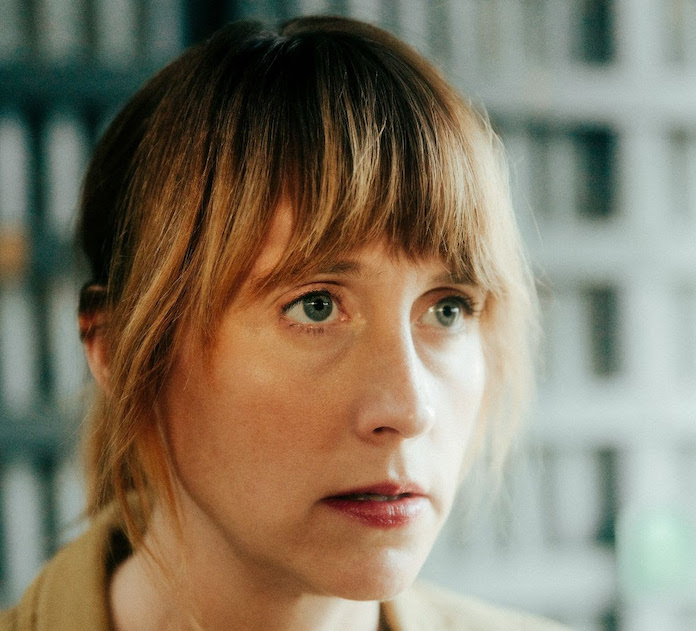
In terms of writing the lyrics themselves the record feels very narrative based and prose like. There’s obviously melodies and choruses and the like, but were you thinking more about what you were trying to say as compared to how it was going to sound? I’m happy to hear that it comes off that way. But no, it definitely wasn’t. It was stumbling in the dark for much of the process. But the process of making it, it was very much one step at a time, and I really didn’t have a fully formed idea. Or I thought I did, but it wasn’t a complete idea.
But the songwriting approach itself wasn’t any different than what you normally would do.
No, but I’m different. There are a couple of things about the approach that were different. I think I allowed some things into the room that I typically don’t and I collaborated with other musicians in a way that I haven’t much. I was aware of the kind of record, the sound of the record I wanted to make. Even though I didn’t have the fully formed idea of the theme of the record, I knew that it was going to be heavy. I knew that it was going to be about addiction. I knew that it was going to be about these formative relationships in my life. And I felt intuitively that I needed to create a record that sounded very beautiful and warm and safe.
I think part of that being so that I could stay with the difficult feelings, like creating an environment in which it felt safe for me to explore this stuff. And part of it had to do with the function of it. I don’t think that I would be putting this music out into the world if I didn’t think that there were other people who could potentially benefit from it in some way. I’m very interested in sort of finding community around shared experience because I felt very alone with a lot of this stuff for a lot of my life. And I think even before I had the full arc of it, I knew that I wanted to make a record that invited you in.
It was important to me that no person would have themselves kicked out that could potentially benefit from connecting with the subject matter by any of the sonic choices that I made. And it’s funny. I sent it to a lot of people. And the response that I received back from it, at least initially in the early stages, was pretty mixed. Some people were like, “This is the best record you’ve ever made.” And some people were like, “This isn’t what I was expecting,” which is par for the course. But one of the first compliments that I really enjoyed that I got from a friend of mine was from my friend, Adam [Schatz], who did play a little bit on the record. And he was like, “I get it. The lyrics are the guitar solo.” And I was like, “Yes, that’s correct. That is correct!”
Yeah. And it’s definitely, like you said, it’s warm and inviting to listen to, so. And I’m thankful for that. Like you said, it’s heavy. There’s a lot to absorb and I think pick up on over time. But what you are saying makes me think of an album like A Crow Looked at Me, by Mount Eerie. Because of how dark and suffocating it is I’ve never been able to listen to that album. I just couldn’t take that journey. I tried and couldn’t.
Oh, it’s devastating. It’s incredible, but it’s devastating. So intense.
So thank you for not doing that in this case, I guess.
We need all the things. We need all the things.
One other thing I saw in the press notes that I thought was interesting, because I’ve had somebody else tell me this, was the avoidance of acoustic instruments in the past. And I guess the first person that told me that was Kate Stables of This Is the Kit.
I love her work so much.
Yeah, yeah. She’s also hilarious to talk to. But she was the first person that told me that about, “I never play an acoustic guitar, and they wanted me to play acoustic guitar, and then they wanted me to use nylon strings,” and just this whole female folk artist thing. And that just had never crossed my mind. So I don’t know if that is the same trope that you’ve been trying to avoid.
It is, yes, of course. It is absolutely the cage, the trap, the female singer-songwriter trap. Not that there’s anything wrong with it—that’s something perfectly good to be. But I think it can feel really limiting. The art that women create is received in a very specific way by our culture. And I have certainly had to take pains in my life to not be pigeonholed in a certain direction. I think a lot of the records that I made when I was younger really came from a place of feeling like I had something to prove as far as the range or the style of music. You don’t want to be boxed in.
I also think songwriting is a craft. It can be autobiographical, but I think people have a certain expectation of women’s work. You forget creative license exists and it’s just all these diary reading kind of autobiographical things. And so it’s very much an intentional choice to not play acoustic guitar. I think the reason why I’m able to do it now—because, of course, it’s never had anything to do with the instrument itself. It’s a beautiful texture. I’m older, and I have a lot of work under my belt. I feel [like now I’m in] a moment where I don’t have anything to prove anymore in a way that’s kind of nice. And I’m just able to be a little bit easier with myself about some of these things. And also, I like the feeling of doing the unexpected thing. I feel like once you set a precedent that people associate you with a certain thing, the last thing I want to do is do that anymore. So it’s a little bit of a combination of a lot of different things.
I get what you’re saying. It’s funny because when Head of Roses: Phantom Limb came out, my daughter and I had gone to the Bon Iver concert the same day it came out in 2022. [Wasner was singing and playing keyboards with the band]. And I had already written about Head of Roses, and I’m like, “Well, I don’t need to write about this too.” But I listened to it on the way driving home. And those two solo piano pieces, just like when you talk about being caught off guard by a simple thing, I was like, “Oh my God, these are just gorgeous.” I didn’t recognize the songs and where they had come from. I had to go back and look it up.
Thank you. I love that. I think that’s a trick that a lot of artists do to sort of keep the things feeling interesting and fresh. Part of the reason why I’ve loved these living room performances that I’m doing, is that things are stripped down but not completely uncomplicated. And I’m playing with my partner who is a phenomenal musician. There’s a lot of space and room for shifting and improvisation because it’s just the two of us. But getting to re-envision songs for my catalog in that format with those limitations is really fun. And I also think I’m more comfortable centering my voice than I ever used to be. And that has been really empowering as a performer as well because my voice is the thing. I think I had a lot of resistance to that over the years as part of my journey. But I feel like I’ve come into a place of full acceptance of the fact that my voice carries a lot of power and that I should treat it as such. And so yeah, that’s part of what about those more minimal performances that feels really good to me right now.
Well, I’m glad you feel safe and free to do that.
Thank you.
Well, Jenn, thanks so much for taking the time. I appreciate it.
Well, thank you. I appreciate you talking to me about it.
Read our The End interview with Wasner about endings and death here.
Subscribe to Under the Radar’s print magazine.
Support Under the Radar on Patreon.

Most Recent
- 500 to Go: Join Under the Radar’s Summer Subscription Campaign (News) —
- 25 Best Songs of the Week: Penelope Isles, Arab Strap, Echo & the Bunnymen, Interpol, and More (News) —
- Penelope Isles Share Video for New Song “I Loved You, Robert Pattinson” (News) —
- Shallow Hits (Review) —
- Echo & The Bunnymen Announce New Album and Share Single “Brussels Is Haunted” (News) —

Comments
Submit your comment
There are no comments for this entry yet.