
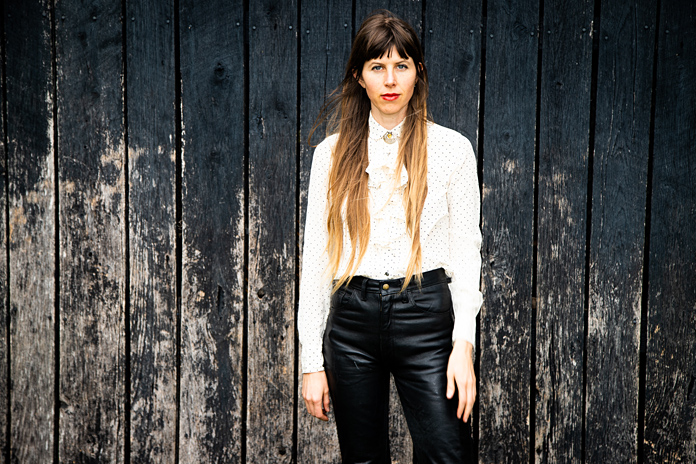
Lael Neale at her family's farm in Virginia.
Lael Neale on “Altogether Stranger” and Seeing Both Sides
Adios to All That Concrete
May 02, 2025 Web Exclusive Photography by Wendy Lynch Redfern (for Under the Radar)
Releasing her third album on Sub Pop in five years, Lael Neale reflects that each of the records she has put out on the label has been a reaction to living in or living away from Los Angeles. “I write in response to the environment [I’m in]. Acquainted with Night was a response to living in LA. More of a pulling in and an internal juxtaposition to the craziness of the city. And Star Eaters Delight was more of an outward push, because I was so isolated during the pandemic being [back] on the farm [in Virginia]. And now Altogether Stranger is my reaction to being back in the city again but more in an aggravated way,” Neale explains.
Ironically, since the new album centers on Neale’s observations of coming back to LA in the Fall of 2023, she and I are talking via Zoom a few days after Neale has returned to her native Virginia. This time likely for good. Neale is currently living on the family farm where she grew up from the time she was 11. The same place she decamped to during the pandemic to write Star Eaters. “I’ve always had this dream of being a gardener and having some land, some chickens. And we already have that [here]. So it seemed natural and a letting go of a past version of myself. But it was hard to do because there are so many special things about Los Angeles and who I am [when I’m] in the city. Your finger is much more on the pulse of what’s happening in the world and in art and music. So this [move] was definitely letting go of that. And that’s okay. I think it’s time. I’m ready,” Neale says.

Neale shares that she has made six cross-country road trips since originally moving to LA in 2011. And naturally that brings to question what kept pulling her back to the West Coast. “There’s nothing like the people there,” she says. “It’s truly a magical place. I will always love Los Angeles. The idea that you can go out to the café and strike up a conversation with anyone and they are already on your wavelength. You don’t have to navigate all the surface level conversations that you sometimes have to have in Virginia.” Neale goes on to explain that back home when people hear that she’s a singer she’ll be asked if she’s been on American Idol. A funny anecdote, but also a telling one that points to the social alienation of being outside of the arts scene.
It’s enough to lead one to wonder whether Neale is back in her element or not. But as Altogether Stranger is her reaction to moving back to LA, the album picks up on her jarring transition back there. Songs like “Down on the Freeway” and “Tell Me How to Be Here” point distinctly to it. “‘Down on the Freeway’ is supposed to sound mechanical and machine-like, which is how society in certain cities feels to me. Very divorced from feeling sometimes,” Neale explains. Living in the hills of Echo Park amongst the “brave houses” that she describes in “Tell Me How to Be Here,” Neale often felt she was in an alien landscape. “I felt very strange in the house. It was empty in a minimalist way. [Partly] because I’m kind of cheap and wouldn’t get the things that would make a home cozy or nice. I couldn’t get comfortable and our next-door neighbor would randomly get up at 3 a.m. and start playing this crazy jazz piano. Or sometimes the cabinets would just pop open at night,” Neale says.
“The overstimulation, the noise, the cars, it’s almost like my nervous system just couldn’t handle it,” Neale continues about feeling out of place in her chosen surroundings. “I was much more anxious and ungrounded and that lends itself in some ways to making art for sure. So it’s not necessarily bad, but I just didn’t want to be on concrete and asphalt all the time.”


In spite of the urban agita, Neale feels there are important reasons for people to experience both the fully charged city life and the more sheltered surroundings of the countryside. “Cities can be sad,” she explains. “There’s a lot of homeless people and there’s a lot of pain and suffering. I think it’s important for everyone to see that and come in contact with it and have compassion for it. That’s what some of the songs on the album are trying to get across. We make all this trash and just put it out on the street. There’s a very direct and visceral understanding of what’s happening in society and the world. Whereas people in rural places are like, ‘What are they making a big deal about?’ I feel like it’s been hugely educational for me to go back and forth between Virginia and Los Angeles. It’s made me have so much more compassion and empathy for people I would completely disagree with on certain things. I see the [only] world that they have ever seen [in Virginia] and it’s different. It’s okay to have compassion for those people too, because they haven’t seen the same things.”
In addition to talking to Neale about the overarching themes of Altogether Stranger and her recent move back to Virginia, we also caught up on other topics including the time from Acquainted with Night until now. I had interviewed Neale prior to Acquainted being released and have found her work to be some of the most fascinating (and different) of the current decade. I wasn’t able to interview her when Star Eaters Delight was released, but since its release over two years ago, it was my last 9/10 rated album for any site. So the occasion of having the opportunity to speak with Neale again after four years was also a chance to catch up. Here’s a little more of what we talked about.

Mark Moody (Under the Radar): When Star Eaters Delight came out, it just wasn’t what I was expecting and I was pretty blown away. You had put out a non-album single between Acquainted and Star Eaters called “Hotline,” which was a little more poppy and playful, so I just didn’t see the left turn of Star Eaters coming. Can you tell me about that?
Lael Neale: Yeah, “Hotline” was kind of always meant to be a one-off. It’s funny. It’s the only song I’ve ever done as a collaboration and it was with my friend Jane, who’s a writer. And so she came up with the concept of it. And so I kind of went off of that concept. And the song is referencing one of my favorite songs called “The Nest” by Jeannie Piersol, which not many people have heard of. So it was kind of a take on this ’60s hidden underground pop song.
I know you had an album a very long time ago [I’ll Be Your Man (2015)], and we talked about that a little bit the first time we talked. But I love that you’ve put out three albums in five years. But did that seem feasible to you in terms of being that prolific?
It really helps to have Sub Pop because it’s like I have some reason to keep going [musically]. You can get lost in this timelessness. It’s like having a teacher or something. You’re like, “Oh, I’m going to write my report and hand it in to my teacher.” And I love that. It’s so helpful because I do really well with deadlines. It creates structure. And I am pretty disciplined.
Sometimes you’re like, ”Will I ever write a song again?” Because you go through cycles. And just for some reason, it was the week we landed in Los Angeles in October [2023]. I just immediately sat down and started writing every single morning. I was really having kind of a hard time acclimating again. And so, that helped to have material to draw from. And that’s why the songs can maybe sound a little more negative than I was actually feeling. I was actually pretty happy, but there was tension.

We didn’t really talk about it the first time because you were new to me, and your music was new to me. And now, you’ve done three albums with Guy [Blakeslee] being involved. I didn’t know about him either. But just kind of curious about that collaboration and how that’s evolved and the import of that?
Yeah, that’s hugely important, as you can tell by the sound of the albums. Because the first one he was the producer, but he kind of was the ghost producer or something. The gift of the way that he did that was to gain my trust, like you would do with a wild animal or something. Like, “Here, just keep in your little container, and you’re free to do exactly what you want to do. And I’m not going to intrude on your space.” So that was his approach with producing and creating that container. That was kind of the gift of the Acquainted with Night album. And then, as I began to trust him more, that he wasn’t going to [take over the project], then I wanted his involvement more. I think he takes the songs to another dimension that I would never be able to on my own. And it’s very rare that he does anything where I’m like, “I don’t want that.” Usually, the most I say is, “Play less notes.”
Maybe we can talk about some of the songs that we haven’t already covered. And I guess we’ve touched on that a little bit. But on “Tell Me How to Be Here,” right at the beginning, when it says, “Choppers cast shadows above the brave houses.” And I know that you wrote this before, but it made me think of the wildfires in LA recently. And I was wondering about what made the houses brave and what that meant, because there were so many houses lost recently?
Yeah, I wrote that a year before the wildfires. But I think I was describing how it feels being in one of those houses, but also seeing them from across the way [from where I was writing in Echo Park]. Because houses to me, especially from afar, have little personalities and they look like kinds of beings. I would look out on this panorama of houses. And then just seeing helicopters, because they’re mostly police helicopters. And it feels very kind of aggressive or invasive. And a lot of the times, they’ll just kind of circle above the neighborhood. And it’s loud. And I would just see these little houses. And I don’t know. I just felt like they were standing strong beneath the surveillance state hovering above them. I mean, lyrics often just pop into my head, and then later, I’m like, “Oh, well, that’s cool.”
That worked well. It kind of made me think about that Wilco song from Yankee Hotel Foxtrot [“Jesus, Etc.”] where he says “tall buildings shake,” and it came out like right after 9/11, and you’re like, “Wow, did they know something the rest of us didn’t know?” Your “brave houses” in context of the wildfires made me think about that. But I think my favorite song, at least at the moment, is “All Good Things Will Come to Pass.” And part of it’s the music. I mean, it reminds me of “Highway 61 Revisited” kind of merged with “Venus in Furs.” Some of my favorite artists kind of just jammed together in a fun way. So there’s this dialogue between God and man and then you sing “shiny, shiny cars.”
It definitely was influenced by “Highway 61” just in the same format of “And God said to man,” and then you can launch into whatever you want and it can kind of go off the rails. Which it does, but that song came in one really quick burst. And it’s also one of my favorites because it’s funny, but it’s also not funny. It’s meant to be light hearted, but also punch you in the gut a little bit. It’s also the only one we recorded live which gives more life to it. Yeah, my version of the history of mankind and where we are today.

And I have to ask about “Come On.” I sent you a little note when I first heard the album because it made me think of the chorus of “The Night The Lights Went Out in Georgia,” and I don’t think you had heard of the song. But you are also singing in a higher register and I was wondering if that was hard for you to do?
I did know it. I just hadn’t heard [the original I don’t think]. But I could pick up on what you were talking about. It’s actually much easier for me to sing in that register, but I don’t want to hurt people’s ears. [Laughter] The songs that are hard for me to sing are “Down on the Freeway” and “I am the River,” because they’re in this low to middle range. It’s actually much easier for me to sing high.
So you’re getting ready to go tour Europe again. You seem to do more of that than a lot of people and it’s kind of why I assumed you were headed back to the East Coast only temporarily. Do you think you do well there because people may be open to hearing something different as opposed to American audiences?
Yeah. It’s kind of where the most action is right now just in terms of people being interested and wanting to go to the shows. We just do well in Europe for some reason. And I’m always just incredibly amazed that a place in Madrid that I’ve never been to that people know the words to the songs. And they show up. Then in the United States, it’s a little demoralizing sometimes to go somewhere where there’s three people.
It does seem to be [that some audiences are willing to listen to me] because I know it’s asking more of people than some music. I’d always heard that about German and Dutch audiences, that they have the patience and attention span to really listen. And then England, it’s like English people seem to really resonate with it. So that’s really exciting to me. Yeah, it’s amazing because I realize that it’s asking a little bit more. It’s just a different kind of sound than some things. It’s also interesting how in some European countries people can be so honest about things. They’ll come and tell me after the show, “Maybe you could do this instead.” [Laughter]

I think that’s about everything I had. I don’t mean to sound silly, but I don’t think I would be a good journalist if I didn’t ask you about your mirror suit. Just in terms of how that kind of came about. And it became kind of ubiquitous in some of your videos.
So what happened with the mirror suit is I got it from this really sketchy website. I thought they were probably going to steal my card, and I would never get anything. And I got it, and I wore it for the “Electricity” video, which was a single. And then as we made this album, we were making an entire full-length video to go along with the album. And the premise is being an extraterrestrial that dropped down from space and is experiencing humanity kind of as an outside observer. And so I had to wear that suit for every single video. And by the sixth video, I was like, “I hate this thing so much. You can’t sit down in it.”
Is it glass or plastic? It looks like it would be heavy.
It’s glass. It’s not really heavy glass, but it’s real glass. And I can’t wash it, so I don’t need to explain what that’s like. But I think in the end, I’m really grateful for it because it definitely kind of gels everything together with this film. But I don’t know how much more I’m going to wear it.
Thanks so much for the conversation and I’m really glad you have new music coming out so quickly. So I’m glad Sub Pop’s cracking the whip, making you put the music out.
Well, they’re amazing. They don’t force anything, but they draw it out of me somehow.


Read our interview with Lael Neale on Star Eaters Delight.
Read our rave review of the album here.
Read our 2021 interview with Lael Neale.
Subscribe to Under the Radar’s print magazine.
Support Under the Radar on Patreon.

Most Recent
- Nottingham Waterfront Festival 2026, The Canalhouse, Nottingham, UK, July 4, 2026 (Review) —
- Sammy Hagar @ British Airways ARC, London, UK, July 9, 2026 (Review) —
- Def Leppard @ The O2, London, UK, July 2, 2026 (Review) —
- The Last Dinner Party Share New Single “Knocking At The Sky” (News) —
- Premiere: DD Island Shares New Single “Setting Sun” (News) —

Comments
Submit your comment
There are no comments for this entry yet.