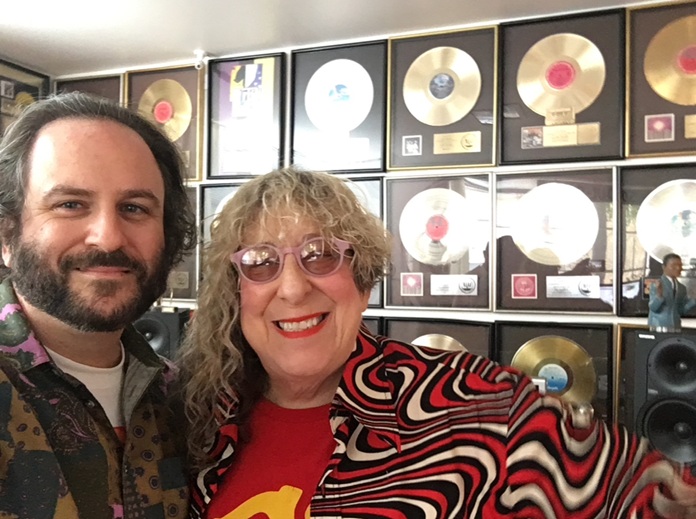
Ben Golomb and Allee Willis, 2019 - Photo by Ernie Trinidad
Modern Time Machines’ Ben Golomb on Collaborating with Legendary Songwriter Allee Willis
“Ornamental” (out 9/2) was the final track co-written by Songwriting Hall-of-Famer
Aug 31, 2025 Web Exclusive
The Washington Post once described Allee Willis as “the most interesting woman in the world who no one has ever heard of.” But even if her name doesn’t ring a bell, you’ve no doubt heard her work, as it was everywhere — not just on the radio, but in many of the biggest movies and television shows of an era that encompassed several decades and many different styles.
In the late ‘70s she landed her first smash hits as the co-writer of Earth, Wind & Fire’s chart-topping “September” and “Boogie Wonderland.” As her talents grew in increasingly high demand, she would be hired to write single after single for artists such as Herbie Hancock, Sister Sledge, the Pet Shop Boys, Aretha Franklin, Al Jarreau, Dionne Warwick, Cyndi Lauper, Billy Preston and many others. As she conquered the R&B and pop charts, Hollywood came calling. Several of her best-known songs were written for a couple of the 1980s’ biggest movies: her credits include Joe Esposito’s “You’re the Best” from The Karate Kid as well as Patti LaBelle’s Grammy-winning “Stir It Up” and the Pointer Sisters’ “Neutron Dance,” both heard in Beverly Hils Cop. (She also contributed undeniably catchy tunes to three of the decade’s more fascinating flops: Howard the Duck, Mac & Me, and D.C. Cab.)
And then came the 1990s:
“So no one told you life was gonna be this wayyyyyy…”
You can hear it now: the guitar riff, the handclaps. Willis co-wrote the theme song for Friends (The Rembrandts’ “I’ll Be There For You”), which won her an Emmy and ensured that if you’re willing to flip back and forth between cable channels, you’ll be able to hear an Allee Willis original every 30 minutes from now until the end of eternity. (She would later receive a Tony nomination for writing lyrics for the Broadway adaptation of The Color Purple, adding another feather to the cap of an illustrious career.)
As a songwriter who primarily handed off their compositions to other artists, it’s not unheard of for a wizard of Willis’ stature to disappear behind the curtains. While she seemed to embrace being called “the most interesting woman in the world who no one has ever heard of,” those who knew her, or at least of her, might feel that her outgoing, convivial personality greatly contrasted with the relative anonymity afforded to her by her craft. She would host legendary parties in her North Hollywood home: a place often called “Willis Wonderland,” colorfully decorated from floor to ceiling with her art and massive collection of pop culture ephemera. Late in her life Willis curated an online “Museum of Kitsch,” where her ability to find beauty and joy where others might have seen tackiness was on vibrant display.
Allee Willis passed away unexpectedly at the tail end of 2019. A documentary about her life and career, The World According to Allee Willis, was released last year, and helped to shine a brighter light on her refreshing views and impressive achievements. This September, the world will hear the final song she had a hand in writing. Co-written with Ben Golomb of the LA shoegaze band Modern Time Machines, “Ornamental” is the end product of an unusual meeting that sparked an instant friendship – and led to one unforgettable songwriting session.
“I grew up as a big fan of the very weird, yet oddly enjoyable 1986 film Howard The Duck. I’m of the so-bad-it’s-good mindset. I didn’t see it in the theater, but must’ve watched it on cable a half dozen times when I was a kid. Allee co-wrote all the rock songs in the film along with Thomas Dolby and George Clinton,” says Ben Golomb, explaining the unexpected path which brought them together. “In fact, I met Allee specifically due to Howard The Duck: my pal, Ernie Trinidad, is directing a Howard The Duck documentary called Howard The Doc: Or How I Learned to Start Quacking and Love The Bomb, and Allee was gracious enough to film an interview for that.”
Involved in the documentary as its score composer and occasionally a film crew member, Golomb tagged along to the interview shoot in 2019. As a fellow fan of all things retro (as evidenced in Modern Time Machines’ video for “Freefall (Can’t Stop),” which he directed), Golomb was instantly wowed by what he saw as he stepped foot into Willis Wonderland.
“Allee’s home really is kitsch heaven,” says Golomb. “Everywhere you look, you’ll see something that brings a smile to your face, especially if you’re a retro pop culture geek such as myself. LSD cologne, Bee Gees action figures. You name it.” He continues: “My chin hit the floor when I saw CHiPs memorabilia in its original box … being an LA native, CHiPs is one of my favorite old shows, mainly for glimpsing exterior shots of late 70s/early 80s LA.”
A spontaneous connection formed between the two musicians on the day of that shoot — one that encompassed far more than just their mutual appreciation for the vintage Erik Estrada cop show.
“The most remarkable thing happened when Allee and I first met. She slid open the front door of her home, and as soon as she saw me, she instantly said something akin to “Have we met before? You look so familiar” We in fact had never met before, but maybe it was some past life stuff going on, I don’t know.”
As Golomb and Trinidad were treated to a personal tour of Willis Wonderland, their discussions stretched beyond the work of Allee’s that they’d come to interview her about. That included the Pet Shop Boys’ “What Have I Done To Deserve This?” — which featured Dusty Springfield, and was one of Golomb’s favorite songs as a youth — and her lone solo outing, the 1974 album Childstar.
“The Pet Shop Boys were one of my first bands that I really, really got into as a kid, where I would re-listen to the albums over and over again, and I’d seek out and purchase all their albums on cassette at places like The Wherehouse, Music Plus, and Tower Records,” explains Golomb, who had to purchase a second cassette copy of their album Actually, as he’d worn out his first. “‘What Have I Done To Deserve This?’” is one of the best songs on Actually, in my mind. It’s just so catchy and dreamy. I had no idea who Allee Willis was way back then. It wasn’t until years later that I started looking more closely at songwriting/producing credits. That track just has great vibes; it lives partly in a hopeful and romantic zone, and it also goes into a darker and moodier zone as the song progresses. Really special melodies that aren’t quite predictable.”
“Allee and I [also] talked about her collection of 8-track tapes of her lone solo LP, 1974’s Childstar, which is a wonderful hidden gem,” says Golomb. “She would purchase copies of them when they’d come up for sale, which is a rare occurrence.” He continues: “Childstar is filled with both melancholy as well as happy retro nostalgic pop culture vibes — and by retro nostalgic vibes, I mean it’s a love letter to pop culture items that were retro in 1974.”
Golomb stayed in touch with Willis after the Howard the Duck interview wrapped, with the two exchanging e-mails. After sharing with her the video for Modern Time Machines’ “Freefall (Can’t Stop), he received a surprising response: the suggestion that they try working on a song together.
“It was flattering,” says Golomb. “I had planned to make a similar suggestion at some point at a future hang (we had talked about me helping her sort and catalog her vintage collection), but Allee just put that collaboration suggestion right out there very quickly, so I of course jumped at the chance.”
“It then felt like that retro TV-themed music video I’d made about a year prior to knowing Allee was a bit of a cosmic gift to have completed (and in hand) for me to share with her… it was like a ready-made calling card, which cemented that we were cut from similar geek cloth. It seemed natural that a collab would happen.”
Golomb and Willis soon convened in his studio. Modern Time Machines’ sound is quite different from the R&B and pop stylings that Willis’ most famous compositions are known for; straddling shoegaze and dreampop, their music has reminded us of the distorted melodies heard from of Slowdive, Ride, or The Jesus and Mary Chain. Willis unsurprisingly wasted no time exploring new sonic territory:
“Allee worked very quickly,” says Golomb. “She had vocal melodies come to her head instantly, and wanted to get them down on tape and immediately move on to the next part. She got into a zone and just created. She would ask me to invent a guitar riff on the spot, and she gave me further direction to loop a section, et cetera. The first day of our songwriting was really about structuring the song into a rough arrangement, and Allee created stream-of-consciousness vocal melodies with some scratch lyrics. Day two was more focused on refining the lyrics.”
“We had a back-and-forth dialog about different lyrical ideas, where we’d bounce ideas off each other and talk about why something would or wouldn’t work. I probably have a history of writing lyrics that are a bit more vague in terms of meaning, whereas Allee brought more direct meanings and imagery to the lyrics, and she nudged me in that direction. That was a meaningful lesson to learn.” He continues: “We also connected over the fact that neither of us has formal musical training. I imagine this is not common for songwriters who are as enormously successful as Allee was.”
After two productive sessions, the two parted feeling enthusiastic about the direction their collaboration was taking them. The holidays were just ahead, and they planned to take a short break before reconvening to keep working on the song at the start of the new year. However, the unexpected happened when Willis passed away just a few days later, on Christmas Eve of 2019. Tributes were made on social media by her many admirers and collaborators; lofty news outlets published obituaries with highlights from her unbelievable list of accomplishments. While the music world bemoaned the loss of an unsung legend, Golomb found himself also mourning a friend.
Golomb put away “Ornamental” in the wake of Willis’ passing. It was several years before he felt ready to return to the song they had left unfinished. However, the piece couldn’t languish incomplete forever, and Golomb eventually began piecing together the rough sketches and musical ideas that they hadn’t finalized during their final writing sessions. (“It was a unique experience filled with different emotions,” he says.) The song gradually worked itself into the setlists of Modern Time Machines’ live shows. With the help of his bandmates and collaborators (Mike Morgan, Olya Volkova, Diana Christine Hereld, Arlene Ziordia, Jacquie Dillon, Nadia Franks, and Kaitlin Wolfberg, producer Josiah Mazzaschi) — Allee Willis’ final song would be heard after more than half a decade.
“Had Allee not quickly suggested we write together when she did, it would not have happened,” says Golomb. “Left to my own devices, I would have probably waited a few more e-mail exchanges to make a similar suggestion, and with Allee’s untimely passing, the collab almost certainly never would have happened. So, I guess it’s a life lesson to not postpone making a move to get your ideas through to the finish line, particularly if for projects you’re passionate about.” He continues: “Allee, more than anything, I think, wanted to lift people up and inspire others, and she certainly inspired me.”
***

Most Recent
- 500 to Go: Join Under the Radar’s Summer Subscription Campaign (News) —
- 25 Best Songs of the Week: Penelope Isles, Arab Strap, Echo & the Bunnymen, Interpol, and More (News) —
- Penelope Isles Share Video for New Song “I Loved You, Robert Pattinson” (News) —
- Shallow Hits (Review) —
- Echo & The Bunnymen Announce New Album and Share Single “Brussels Is Haunted” (News) —

Comments
Submit your comment
There are no comments for this entry yet.