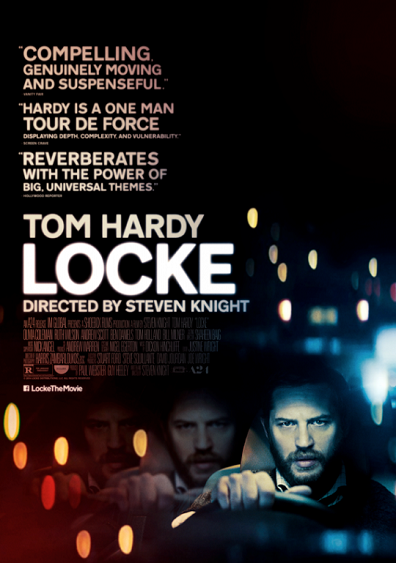
Tom Hardy and Filmmaker Steven Knight On “Locke”
Turning Limitations Into Advantages
Apr 24, 2014 Web Exclusive
The night before the biggest challenge of his career, Ivan Locke receives an unexpected phone call that forever changes the course of his life. As he speeds down the highway to London, he makes a series of calls that torpedo his career, tear apart his family, and sacrifice everything he’s loved and worked for in his life up until that moment. The question of just why this man would do such a thing is central to filmmaker Steven Knight’s riveting new film, Locke.
For actor Tom Hardy, who is well-known for taking on larger-than-life characters—including the violent criminal at the center of Nicolas Winding Refn’s Bronson and the masked villain, Bane, in The Dark Knight Rises—the down-to-earth Ivan Locke is a much more muted role than we’re used to seeing him play.
“For me, what was interesting about Locke—which was juxtaposed against anything I’ve played before—was an essence of containment,” says Hardy. “You don’t have any physical exposition for who he is. [He’s not] overtly bombastic or violent. Having said that, there’s a huge amount of vengeance and aggression in Ivan Locke, which is deeply-rooted, and you never see.”
“The whole premise of the film is to look at an ordinary man and see an ordinary tragedy,” says writer and director Steven Knight. “And do justice to the drama in so-called ordinary lives.”
The entirety of the film plays out inside a moving car, almost in real-time, with Hardy being the only actor you ever see on screen. While committing to this approach put limitations on what filmmaker Steven Knight was able to do while shooting, it offered a few benefits, as well.
“The advantage of shooting everything in one space is that there are no continuity issues; the background is always changing,” says Knight. “When you get to the edit, you can choose according to performance rather than anything else.”
“There are boundaries within that space,” says Hardy. “I had—in the literal sense—my GPS system, a box of medicine … the rearview mirror, wing mirrors, and the road ahead. So it was a safe space to explore.”
The limited nature of the story—one character, alone, driving and talking on the phone for 90 minutes—allowed the cast and crew to film the entirety of the movie each night of their weeklong shooting schedule. This unorthodox approach to filmmaking gave Locke the feel of a live theatrical production.
“I’m following a script [on a teleprompter] and I’ve also got phone calls coming in from a live feed into my ear,” says Hardy, who’d received the script just days before shooting began. “I had to speak to my ensemble—who are in a hotel room and calling me live—and react to them in real time, as well as being on the back of a low-loader, driving down the M1, watching the cars go by. And I had a cold! So, my life wasn’t so dissimilar to Ivan Locke’s at the time.”
Beyond the artistic and technical reasons, Knight chose to set all of Locke in a moving vehicle because of what that confinement was able to share with us about its namesake character.
“The nature of the space and the nature of the journey offer up all kinds of metaphors that you don’t have to force,” says Knight. “In other words, Ivan’s future is through the windscreen. It’s there; it’s ahead. His past is in the rearview mirror.”
Locke opens in New York and Los Angeles this Friday, April 25th. For more information about the film or to see opening dates in other cities, check out locke-movie.com. To read our review of the film, click here.

Most Recent
- Watch Jerkcurb Perform “Help You” in a New Under the Radar Art Studio Video Session (News) —
- 500 to Go: Join Under the Radar’s Summer Subscription Campaign (News) —
- The Beta Band @ The Limelight, Belfast, Northern Ireland, UK, July 21, 2026 (Review) —
- Wild Pink Share Video for New Song “500 Is The New 250” (News) —
- Premiere: Adjenai Shares New Single “Early Mourning” (News) —

Comments
Submit your comment
There are no comments for this entry yet.