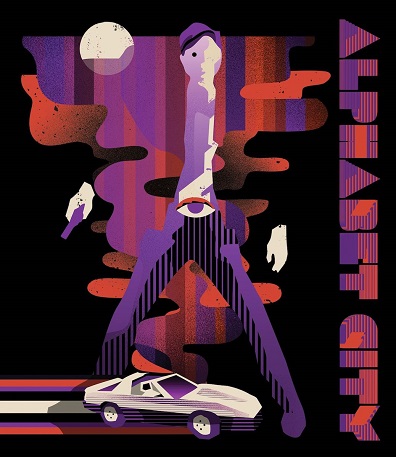
Alphabet City
Studio: Fun City Editions
Sep 03, 2020 Web Exclusive
Johnny works in middle management for one of the Lower East Side’s most dangerous criminal organizations. The up-and-coming youngster has the smarts to be Alphabet City’s next top crime boss, but not the ruthlessness necessary for the job. When he’s asked to do the unthinkable—set fire to his mother’s tenement building in an insurance scheme—it’s the final straw, and Johnny decides that this will be the night he finally skips town, changes careers, and starts fresh somewhere new with his wife and infant. There are two things standing in his way: a long to-do list of unfinished criminal business, and the knowledge that the only way people leave his line of work is in a casket. What started out as a routine night at the office turns into a tense struggle to escape the mob with his life.
From The Blank Generation (1976) director Amos Poe, 1984’s Alphabet City is a low-budget thriller soaked with slick ‘80s style. The movie was shot in the crumbling, apocalyptic cityscape that was downtown New York in the early part of the decade, where artists, junkies, and clubbers crossed paths in the wee hours of the nights. In Alphabet City, this world is shot with such an expressionist lens that it looks more like an FW Murnau or Fritz Lang film than any typical crime movie of the era: shadows and abandoned buildings loom over our hero in many shots, mysterious fogs bellow from alleyways, and there’s barely an intersection without its own burning barrel of trash. Although it doesn’t rain, the city is perpetually wet, so that traffic signals reflect off puddles and neon signs illuminate their surroundings with eerie pinks and greens. Every headlight diffuses and twinkles like a star in the camera’s lens.
And by damn, does all of this look so incredibly cool.

There’s a point in many films where hyper-stylization becomes too much, or where it looks like a filmmaker is trying too hard. Alphabet City pushes past that point, becoming a film that’s as much about its aesthetic as its content. It’s an unusual combination of authenticity—the grungy downtown shooting locations are shot with candy-colored filters over the lighting, lit with candles, or art directed with such an eye for color and pattern that it’s as if they’re decorating a Sirk melodrama. Long takes abound, performances are heightened. Johnny drives the ‘80s most badass Trans Am, and the soundtrack—courtesy of famed superproducer and Daft Punk idol Nile Rodgers—propels the movie forward with atmospheric, post-disco grooves.
It’s impossible to overstate this movie’s cool factor. This is the sort of style and atmosphere that you have to figure Nicolas Winding Refn dreams about making when he closes his eyes at night.

Of course, all of that stylization would be worth jack all if the movie didn’t have the substance to back it up. It does, mostly thanks to a strong cast of young stars and veteran character actors. As Johnny, Vincent Spano grounds the movie playing its conflicted hero—this was made immediately on the tail of his working for Coppola on Rumble Fish (1983). The movie introduces Kate Vernon (TV’s Falcon Crest and Battlestar Galactica) as his long-suffering girlfriend, and features early appearances by Michael Winslow (Police Academy) and Jami Gertz (The Lost Boys, Twister). Taking place over the course of a single bad night, the movie’s pace never wanes. The final act—when it’s clear Johnny’s life is in danger—brings the movie to a frantic, legitimately scary close.
Alphabet City is the inaugural release from new label Fun City Editions, who promise to dig up overlooked treasures for reissue—which this debut disc certainly delivers on. This is a movie that was well deserving of a restored edition: as star Vincent Spano comments in an on-disc interview, the crew only had a single generator on set, making it difficult to light many scenes. The results are a dark film, one in which a whole lot of detail was lost when blacks became murky in older transfers—yet, it’s as clear here as it probably ever looked. (Poe’s wild use of color greatly benefits from the extra pop of HD—a rainbow-colored, mid-movie dance club scene looks like a Skittles commercial dragged through vintage grime, and it’s deliriously eye-grabbing.) Other features include a video essay, new audio commentary by Poe and author/historian Luc Sante, a trailer, and stills gallery. Even the menu is appropriately hip, opting to divide the film by reels rather than chapters. That’s cool.
This is a great package, and well-recommended to fans of stylish thrillers—or, to at least soak up the neon glow and long-gone ambience of pre-gentrified lower Manhattan. As long as boutique labels continue to bring us this level of cinematic archeology, well, the death of physical media is still a long ways off for the true film fan. We look forward to learning what Fun City Editions will unearth next.
(vinegarsyndrome.com/products/alphabet-city-fun-city-editions)


Most Recent
- Watch Jerkcurb Perform “Help You” in a New Under the Radar Art Studio Video Session (News) —
- 500 to Go: Join Under the Radar’s Summer Subscription Campaign (News) —
- Joe Jackson @ Beacon Theatre, New York, US, July 18, 2026 (Review) —
- The Dink (Review) —
- Lambchop Share New Song “The New World Wave” (News) —

Comments
Submit your comment
There are no comments for this entry yet.