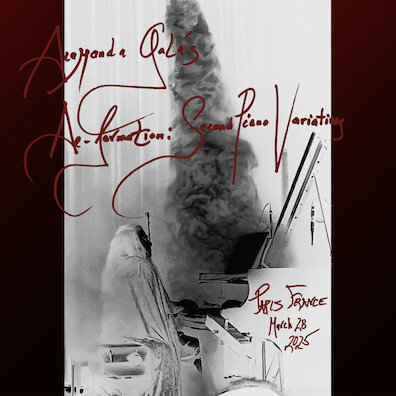
Diamanda Galás
De-formation: Second Piano Variations
Intravenal Sound Operations
Nov 11, 2025 Web Exclusive
The word legend is bandied about a bit too much these days—suggested for any musician who lasts a decade and releases three good albums, bestowed on any artist who headlines a festival and plays for over an hour. Real legends don’t just turn up at Glastonbury at 8 p.m. and play some songs to the masses after two albums of 18-month recording/touring schedules. Real legends work tirelessly at their craft for decades, pushing the boundaries of their creative essence again and again and again.
When I think of legends, few names spring to mind, but one that is always near the top is Diamanda Galás. Since the late 1970s Galás has constantly taken us, and herself, to the edge of the abyss. Albums such as 1982’s The Litanies of Satan, her 1984 self-titled debut, 1991’s live Plague Mass, 2003’s Defixiones: Will and Testament, and 2022’s Broken Gargoyles have challenged our preconceptions of not only what an album could be but should be. Great albums should say something. Make us feel differently after listening and run the gamut between genius and madness. Few have done what Galás has and as consistently.
In 2020 Galás released De:formation: Piano Variations. This was a release that, at the time, I enjoyed, but in the intervening years has been the release I return to again and again. It is simply Galás playing the piano live in the studio. No vocals. No apparent overdubs or editing. It’s as powerful as anything she had released to date. At first, it was hard to understand. It was like a Rubik’s Cube found in the back of a childhood drawer. How had it gotten to this point of confusion? The more time spent trying to complete it, the less you understood how the thing was meant to be solved. Eventually, after a year or so, I thought I had a handle on it and moved on to other things, returning from time to time to see if my assumptions were correct. Fast forward five years and Galás has now released a second iteration of solo piano workouts.
De-formation: Second Piano Variations picks up where the first left off. It is a live reworking of the first. More a recital than a traditional live album. Recorded live in the basement room of the Pinault Gallery in Paris, the recording is about soldiers with the final stages of yellow fever in World War I. Their pain unbearable. Their deaths are close. The music is haunting, harrowing, but with flourishes of hope. A hope for a cure or quick end perhaps? Disease, and death, is a common theme of Galás’ work. Throughout the 1980s and 1990s she focused on the AIDS epidemic and Broken Gargoyles was again about soldiers, but this time soldiers who had been mutilated by shrapnel, poisoned by mustard gas, and undergone facial surgeries. With De-formation: Second Piano Variations, Galás, along with pianist Thomas Feng, created a full score of the original and then over months painstakingly relearned the piece, whilst recomposing it in the process.
It opens with a dank hammering of the keys. Under this builds tremors of sound. Heavy flourishes of noise and rhythmic disorder follow. These sections are punctuated by silence. Are these added to give us, or Galás, a momentary break? A chance to digest what we’ve heard before the next salvo starts up? Or a slight reprieve before the real heavy stuff starts? After the opening few minutes there is a pause. When Galás returns the music is slightly faster, but not as dramatic. It’s subtle and one of the prettiest sections of the song. This gives way to heavy chords, underpinned by delicate, dare I say, melodies. Around the halfway mark the music takes on a more jovial tone. Jovial isn’t the right word, maybe reprieve is, but compared to what has come before, the music is slightly lighter. The notes lilt more in the air. It’s refreshing and much needed. De-formation: Second Piano Variations closes on a more contemplative mood. Yes, the power of her playing is there, but the intensity has been subdued. Her strokes are forceful, but more graceful. As the final notes hang in the air, you feel that you haven’t just heard an exceptional piece of music but lived it.
At its heart De-formation: Second Piano Variations is as dark and challenging as anything Galás has released to date. It’s also one of the most powerful releases in her stacked back catalogue. It shows, again, Galás doesn’t need words to get her point across. She just needs a piano. Let’s hope that there are more solo piano works in the future, or her vault, as this is a side of her that needs to be heard more. Her renditions of “O Death” and “I Put a Spell on You” are captivating and glorious when she hammers the piano wails and writhes, but what we wouldn’t give for an album of shorter pieces that showcase her fluidity as a player. At 70 years old, Galás’ status is assured, so what are they waiting for? Put her on the main stage and let her deliver something complex and awe-inspiring, the crowd can take it. (www.diamandagalas.com)
Author rating: 8.5/10
Average reader rating: 9/10

Most Recent
- 500 to Go: Join Under the Radar’s Summer Subscription Campaign (News) —
- 25 Best Songs of the Week: Penelope Isles, Arab Strap, Echo & the Bunnymen, Interpol, and More (News) —
- Penelope Isles Share Video for New Song “I Loved You, Robert Pattinson” (News) —
- Shallow Hits (Review) —
- Echo & The Bunnymen Announce New Album and Share Single “Brussels Is Haunted” (News) —

Comments
Submit your comment
There are no comments for this entry yet.