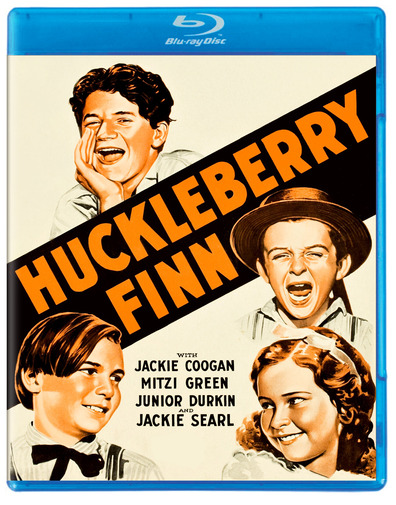
Huckleberry Finn
Studio: Kino Lorber
Oct 03, 2025 Web Exclusive Photography by Kino Lorber
Very few characters in American history have captured the American zeitgeist like Tom Sawyer. First published in 1876, Mark Twain’s The Adventures of Tom Sawyer quickly became a household novel that captured the hearts of families and offered a playfully nostalgic escape from a nation still reeling from the Civil War’s devastation. By the 1920s, aided by the rise of the high school movement and the growing push for American nationalism, Tom Sawyer reached its peak in American culture.
Naturally, Paramount Pictures started churning out film adaptations of this beloved story. They released three silent adaptations between 1917 and 1920 (Tom Sawyer, Huck and Tom and Huckleberry Finn; all directed by William Desmond Taylor), and the advent of sound ushered in a reboot of the franchise in 1930. With Jackie Coogan (“the kid” in Charlie Chaplin’s The Kid) as Tom, John Cromwell directing and Charles Lang behind the camera, they turned the 1930 Tom Sawyer into the biggest box office hit that year. With such success on their hands, Paramount decided to produce this adaptation of Huckleberry Finn for release the following year.
In Huckleberry Finn, the child stars (Jackie Coogan, Junior Durkin, and Mitzi Green) each reprise their roles from Tom Sawyer; Grove Jones and William Slavens return to adapt the screenplay. Otherwise, most of Tom Sawyer’s production team did not return. While the acting and technical elements of Huckleberry Finn are perfectly adequate, they aren’t enough to compensate for a screenplay that lacks depth and erases most of Twain’s story.
While Twain’s The Adventures of Tom Sawyer is childlike and fun, The Adventures of Huckleberry Finn is not. The novels may share characters and a mischievous, episodic structure, but Huckleberry Finn carries a seriousness and moral weight that Tom Sawyer doesn’t touch. So instead of actually adapting Twain’s masterpiece, the film exploits the novel’s name in an awkward reimagining that turns Tom Sawyer into a lead character (he, too, is on the raft in this version) and abbreviates the entire Mississippi River odyssey into an 80-minute, two-episode ‘white picket fence’ boyhood adventure.
In this telling, Huck’s central conflict largely revolves around his fear of cooties and not wanting to sit in school learning how to spell “Pennsylvania.” Adding Tom Sawyer into the adventure turns all of Huck’s escapades into games of pirate play. And perhaps most notably, the screenplay completely ignores Jim’s status as a runaway slave, avoiding any acknowledgement of the novel’s central conflict. It seems that Paramount wanted the revenue from putting out a sequel, but they didn’t want to deal with the actual themes of Twain’s material.
Paramount’s 1931 adaptation of Huckleberry Finn represents one of the earliest examples of the “cash-grab sequel.” They attempted to duplicate the success of the original by recycling Tom Sawyer’s whimsical adolescence and shoehorning it into a hollowed-out adaptation of a far more complicated tale. Had Huckleberry Finn not been reissued, I never would’ve known that it was one of the grandfathers of disappointing sequels such as Jaws 2, National Lampoon’s European Vacation, and Son of the Mask.
(kinolorber.com/product/huckleberry-finn-1931)

Most Recent
- Nottingham Waterfront Festival 2026, The Canalhouse, Nottingham, UK, July 4, 2026 (Review) —
- Sammy Hagar @ British Airways ARC, London, UK, July 9, 2026 (Review) —
- Def Leppard @ The O2, London, UK, July 2, 2026 (Review) —
- The Last Dinner Party Share New Single “Knocking At The Sky” (News) —
- Premiere: DD Island Shares New Single “Setting Sun” (News) —

Comments
Submit your comment
There are no comments for this entry yet.