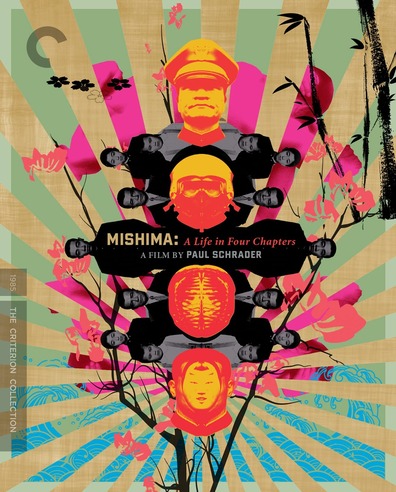
Mishima: A Life in Four Chapters [4K UHD]
Studio: The Criterion Collection
Jun 12, 2025 Web Exclusive Photography by The Criterion Collection
If you’re a cinephile, chances are you’ve been subjected to a seemingly endless barrage of biopics, a genre so routine and “Oscar bait”-y that the majority of its films almost feel indistinguishable. After watching enough biopics, you start to feel as if the ‘subject of the day’ has been plugged into a non-changing algebraic formula—the narrative beats and stylistic features always feel the same. The paradoxically exciting thing about a genre that feels unexciting: every once in a while, when a biopic is able to surpass the clichés that plague the genre, it can be even more impactful than you’d ever expect.
It’s almost better to not even consider Paul Schrader’s magnum opus, Mishima: A Life in Four Chapters, a biopic at all. While the film does play as a portrait of celebrated Japanese author Yukio Mishima, it breaks the biopic mold to such an extent that it doesn’t even feel remotely related to the genre. As its subject would likely greatly admire, the film operates more as “poetry.” After all, the film’s raison-d’être centers around Mishima’s idea that “Perfect purity is possible if you turn your life into a line of poetry written with a splash of blood” (a quote from the novel Runaway Horses, which plays a major role in the film itself).
Instead, Mishima is as much of a film about the author as it is an exploration of the synthesis between reality and art—both constantly influencing one another, in striking ways. To reinforce this idea, Schrader’s work constantly plays with the audience’s narrative and temporal expectations (for a biopic of course, but even for a film in general) .
The major event propelling the film’s narrative follows Mishima, and four of his companions, driving to a Japanese military base to execute a coup on November 25, 1970 (in what would be the last day of Mishima’s life). For the film’s first three chapters, this narrative operates as a framing device, enclosing black-and-white flashbacks that center around key moments in the author’s life. These flashbacks, in turn, are mixed together with interpretations of Mishima’s work, shot in radiant color. The narratives and themes of the chosen works—novels The Temple of the Golden Pavilion, Kyoko’s House, and Runaway Horses—directly match the topics addressed during the real-life flashback sequences. The final chapter details the events of November 25—particularly, what happens after Mishima and his companions arrive at the military base.
This is how you honor an artist—by contorting the filmic form and narrative to best represent the way the subject sees life, beauty, and art. By watching all these narrative styles intersect with one another, you emerge with such a greater and more complex understanding of how Mishima understood the world, and how the battles he faced throughout his life directly manifested themselves into his works. Just altering the narrative style likely would have been more than enough to communicate these ideas. But, John Bailey’s stunning cinematography and Eiko Ishioka’s unforgettable production and costume design add yet another dimension to this complexity. The detail and precision with which the adaptation scenes are rendered operate in striking contrast to the purposeful straightforwardness of the flashback scenes. This stylistic juxtaposition serves as fascinating commentary into the way art functions as more than just a retelling (or remixing) of reality; the purity and liberty that art provides allows us the rare opportunity to transcend reality itself.
I’m shocked I’ve made it this far into a review of Mishima without mentioning Phillip Glass’ incredible, one-of-a-kind film score, which elevates and propels the film from the moment its opening credits roll. Glass’ score is energetic, frenetic and full of life; there’s not one sequence where its presence feels out-of-place or overwrought. It also perfectly accompanies the film’s imagery. Even days after seeing the film, it’s hard not to listen to the score without recalling the utopia-like production design of the Temple of the Golden Pavilion’s adaptation or the striking cinematography that exquisitely captures the Runaway Horses sequence.
The Criterion Collection’s 4K UHD re-release of the film features a stunning 4K digital restoration of the director’s cut; this is a film you want to see in the highest definition possible. The release also includes a variety of notable featurettes. Audio commentary with Schrader and producer Alan Poul, along with a program on the making of the film that feature number of crew members (including Ishioka and Glass), are great companions to the film. A program on Mishima, an interview excerpt with Mishima from 1966, and a 55-minute television documentary on the author (from 1985) provide additional insight into the author, his work, and his personality.
(www.criterion.com/films/588-mishima-a-life-in-four-chapters)

Most Recent

Comments
Submit your comment
There are no comments for this entry yet.