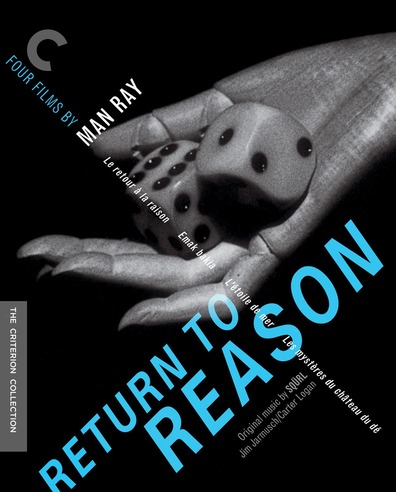
Return to Reason: Four Films by Man Ray
Studio: The Criterion Collection
Dec 29, 2025 Web Exclusive Photography by The Criterion Collection
Having made a significant impact in the art world by the early 1920s through his work with multiple forms, it feels natural that the restlessly creative Man Ray would eventually consider film as an artistic vehicle. “My curiosity was aroused by the idea of putting into motion some of the results I had obtained in still photography,” he later wrote. Return to Reason: Four Films by Man Ray collects four avant-garde shorts from the ’20s that were both influential in style and innovative in production.
1923’s Le Retour à la raison offers his first steps in this new direction. The three-minute film is a disorienting yet mesmerizing extension of the process he called the ”rayograph,” where objects are placed directly onto photosensitive paper and subjected to light. Salt and pepper as well as thumbtacks, pins, and other items spring to life on the screen, eventually juxtaposed against a slowly rotating nude figure. With this new art form ignoring conventions such as a script, the effect would have certainly been jarring to those witnessing it at the time, though inarguably refreshing as a daring new artistic pursuit.
Titled after a Basque expression usually translated as “leave me alone,” 1926’s largely improvised Emak bakia follows a reprise of elements from Le Retour à la raison with extended, hypnotic sequences of repetitive motion. Inspired by a car ride in which his driver nearly collided with a flock of sheep, the incident is somewhat simulated by Man Ray tossing his camera in the air while it was still running. Legs dancing the Charleston, manipulated natural scenery, figures with varying emotional responses, and bits of stop motion animation are among the diverse elements found in this “ciné-poem.”
Based on a poem and screenplay by Robert Desnos, 1928’s L’Étoile de mer features scenes shot through gelatin or mottled glass that result in a dreamlike quality, and brief sequences are woven with brushes of plot detail. Though the desire of the patrons involved with the production of 1929’s Les Mystères du château du Dé was for the film to showcase their château and artwork in something akin to a home movie, Man Ray displayed only the backs of paintings in the camera’s movement through the house, captioned as “The secrets of paintings.” Rolls of dice prompt the action of various actors who are masked with silk stockings, protecting the identities of actual houseguests who appear in various scenes while providing the effect of having them seem like intruders.
For this edition, the musical score is provided by the Jim Jarmusch-Carter Logan collaboration Sqürl, who present complementing music that perfectly matches the films’ moments of tension and foreboding. Extras include a 2023 concert featuring Sqürl performing their semi-improvised score to Man Ray’s films, an interview with Jarmusch and Logan, and an essay by author Mark Polizzotti.
(www.criterion.com/films/34101-return-to-reason-four-films-by-man-ray)

Most Recent
- Watch Jerkcurb Perform “Help You” in a New Under the Radar Art Studio Video Session (News) —
- 500 to Go: Join Under the Radar’s Summer Subscription Campaign (News) —
- Joe Jackson @ Beacon Theatre, New York, US, July 18, 2026 (Review) —
- The Dink (Review) —
- Lambchop Share New Song “The New World Wave” (News) —

Comments
Submit your comment
There are no comments for this entry yet.