
Anna Vogelzang on New Album “Afterglow”
Before, After, Becoming
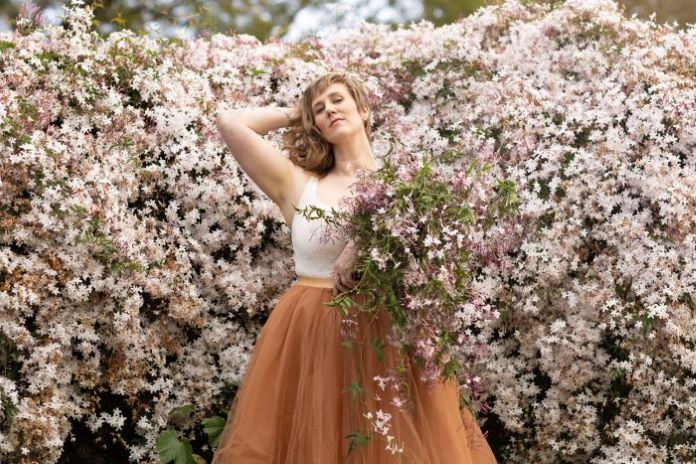
Aug 20, 2025 Web Exclusive Photography by Carla Richmond
Chicago based singer-songwriter and multi-instrumentalist Anna Vogelzang is by no means a new face in the landscape of indie folk, or the music industry—her most recent album, Afterglow (released independently on June 13, 2025), is her eighth studio record, and her resume of collaborations is long and storied. But Vogelzang is also an artist who is deeply dedicated to grassroots, community-building DIY musicianship, uplifting and supporting others just as much as she has nurtured her own career. It’s a path that often proves frustrating for artists who prefer to seek shortcuts to nebulous ideas of success. For Vogelzang, though the path has been long and winding, it has also been paved with wildflowers and magic—and those experiences, those moments, are what make up the glimmer and flare of Afterglow.
We spoke to Vogelzang about her new album, her DIY roots, and the process of becoming.
Mariel Fechik (Under the Radar): How did Afterglow come to be?
Anna Vogelzang: Late in 2022, I decided to go record a few songs with my friend Anthony da Costa in Nashville. We’d collaborated remotely a little bit during COVID and I knew I wanted to record a song (“Searchlight”) for my sister’s upcoming wedding—it was a fun excuse to go hang in his studio IRL. Anthony and I first met way back in 2007, and he’s such a deep friend that I really just wanted to make stuff together.
We recorded four songs during that session, and as soon as I got home we both agreed we should dive head first into a full record. There were some bumps in the road—I went through a vocal injury and couldn’t sing for about six months of 2023, so we had to postpone the second session—and we took our time on the back end, wanting to make sure we released it in the way that best fit the project & where I’ve been at, reemergence-wise. The songs themselves go back to 2020, when I’d joined a new song-a-week challenge online with my friend Matt the Electrician. So when Anthony and I sifted through to pick the album songs, we had 144 to choose from—which is bonkers.
Can you talk a bit about the song “Hometown”? It feels very personal and like it fits into a greater narrative about learning from the past.
“Hometown” kind of tumbled out of me. I was thinking of the town I grew up in, outside of Boston, and all of the mischief we got into—driving around singing at the top of our lungs, sneaking out of the house late at night with usually just a discman’s headphones accompanying us. This idea of languishing as a teenager, wanting what you can’t have, wanting to be an adult but not quite ready for it… well ok, first off, this album is really about the rebuilding of self after big life events—the ones that have leveled you, where you feel like you have to start over. Part of that looking forward and taking stock in order to rebuild is also looking back at your past, at who you were then, and where you came from. For me, “Hometown” really encompasses what it felt like to be 17—for me and, I think, for most—and it speaks to that feeling of friends as chosen family, and being stuck in a loop of yearning that feels ubiquitous across the teenage years of becoming.
I think “Seventeen” is my favorite song from this record. It feels suspended in a floaty space. Is that a feeling you were aiming for sonically with this album?
Yes, “Seventeen” definitely was supposed to feel liminal and floaty, and perhaps like you’re being suspended in space. The song is about my very first love, who I met on a high school singing trip in Europe. She was from London, so after our month-long love affair, we tried to have an overseas relationship—and it was pre-cell phone so everything was essentially over email. It was heartbreaking, but the month itself in Europe still feels like a movie in my mind, completely cinematic. That idea was what I wanted to write to, and the sonic texture we were going for. I even checked in with her before we recorded it to make sure she was OK with our story being put on tape (luckily she was!).
Aurally, this record absolutely tries to create that floaty atmosphere. I think that Beacon, thematically, was an album of liminal space, being in between two things on the threshold of becoming a mom for the first time and trying to find a sense of place. To me, Afterglow is waking up in this new place after transformation, and deciding who you want to be, how you want to rebuild yourself—and how many times this happens after all of the events in your life that created a before and after. Similarly to “Hometown,” “Seventeen” looks back at where I came from—so before I ever fell in love—and the song tells the story of the moment that changed my life forever. I think when you’re in a moment like that, where you know your life will be different from here on out, everything feels very floaty because you know you’re on a threshold of great change: not who you were before and not yet who you’re in the process of becoming.
Community, especially musical community, seems incredibly important to you. I know you’ve changed your home base several times, and that must be hard! Talk about this a bit.
You are so right on both of these fronts. I spent my first decade of playing shows out on the road—building micro-community in each town and essentially tying them together with my Mercury Sable. As I mature, I’ve realized I’m an introverted extrovert—I love the energy I get from being with people, but I also hit a wall of overstimulation and need to retreat for a bit. I think that’s why DIY touring, almost always solo at that time, worked so well for me.
It was a few years later during my time in Madison (where I lived for eight years) that I realized I’d been neglecting the home base—not entirely, of course, but other than playing a few shows a year I didn’t feel like I was digging in or creating anything. In 2012, my fella made a joke about an all-indie-folk holiday show with our hometown friends, and it kicked me into creating Wintersong, a six year run of a charity concert that expanded from 100 attendees in its first year to 800 in its final. It featured the best indie bands in Madison and became bigger than any of us as individual artists.
Leaving that community was extremely difficult, especially since I felt like I’d worked so hard to nurture and cultivate a specific part of the scene, and was finally feeling like I could see that work paying off. When we left Madison for LA, I was heartbroken at how much unknown lay in front of me, but LA had its own magical unfolding of community and friendship—more than I ever could’ve expected. My friend Adam Levy and I co-hosted a songwriting group at my house every week from 2016-2019, and that Song Salon became a place where working songwriters could be together, hang out somewhere other than a gig, pass around the guitar, and get feedback on new work. All the while I was working on my album Beacon with Tyler Chester, who I’d met through Adam, both of whom introduced me to a host of amazing friends and players.
I think a huge piece of community is showing up—I spent so many nights in LA at shows, meeting folks and watching heroes of mine share the stage with up-and-comers. That scene felt so heavily driven by community, and when it was time to leave at the end of 2019, I was heartbroken all over again. We relocated to Chicago, and little did we know that the pandemic was coming our way—I really only had about three months of going to shows and meeting other artists before everything shut down. I was also pregnant—so all that community-building work of going out to shows, supporting the scene, talking loudly and closely at a bar, trying to nurture something—it all seemed so far away and truly scary. I wrote furiously, but it felt like I didn’t come back into the real world for a year or two after my peers, especially since I had a new baby in the house.
In 2023, I started a series in Chicago called Song Club—essentially trying to combine what I’d curated in the various communities I’d previously been part of—and we did three of those shows. The idea was a songwriter night where we all wrote a song based on the same theme and talked about the process on stage, a look behind the curtain. By then I was already working on Afterglow, and by the end of the year, the juggle of the series with the record got to be a little too much and I knew I had to put it down—just for a little while. I’m excited that we’ll be doing our first Song Club back in September as part of the Evanston Folk Fest here in Chicago. I would love to turn it into a podcast sometime—to me it’s the culmination of creative community in action.
What kinds of art were you consuming as you worked on Afterglow? I know for me, books, albums, or other artforms can really color my memories of a time period.
A good friend of mine, Hannah Rose Dumes, is an incredible painter and I finally purchased one of her works as I was working on this record. I loved it so much, I’d even considered asking if we could use it as the album cover. Her work is abstract & she works in multiple layers, and with each new layer the whole image transforms into something new. I’ve been low-key obsessed with her paintings forever, but I was absolutely digging more into her work when we made this album.
Are there artists in other mediums that you feel directly influence your work as a songwriter and artist?
I have been thinking a lot about my friend Andrea Gibson, who passed away [in July], and I opened some of their books when I heard the news—I had forgotten that one of the opening lines to a very old song of mine, “Undertow,” was a direct reaction to reading one of their poems. Especially in the last few months of release season, I’ve been trying to really focus on the heart-wrenching beauty of the world around us, the enoughness of it—something Andrea embodied with enviable earnestness.
I love reading other musicians write about music and non-music alike—I’ve been loving the Substacks of Neko Case, Thao, and Casey Dienel recently. I also love Liana Fink’s newsletter and comics about parenting as a freelance artist, and Yumi Sakugawa’s work on creative process. I also spend a lot of time reading and following along with different astro folks, most often the Moon Studio. That work really gives me a basis for exploration, astral connection, and tarot interpretation that heavily makes its way into my creative process.
The press release mentions that this album has a lot to do with your relationship to the music industry. Can you expand on that?
I have talked about this a lot on stage, but every time I have a kid or put out a record, I feel leveled. Like my sense of identity has been stripped away, and whoever I was before this big event is gone, and I have to decide who I’m going to be now, in this moment. Choosing a path—within an industry that is so difficult—over and over can make you feel insane. I’ve had so many amazing wins in my career and I’ve also worked my ass off for—depending on your perspective—only modest reward. So to continue to choose it feels almost radical sometimes. I want to keep showing up and keep making stuff—even though the industry can trick us into believing there isn’t enough for all of us. But there is. I also think that when women become mothers, we start to feel even more overlooked or unimportant to the greater population, so again choosing something where I don’t feel valued or seen? I had to make sure I really wanted it still.
I also look around at other moms who are doing it so well, and I know there is a path ahead that is possible, and I admire them all so much. It’s still been one of the most challenging relationships in my life, my relationship to this field. “King and Queen,” for example, is essentially a song that I wrote to the music industry, almost lamenting the fact that I continue to choose this relationship that often feels toxic and causes me a lot of psychic pain. The work for me, especially in motherhood, has been to shift my relationship to the music industry, give it less power and know that I am doing this work for my own legacy and my own creative joy. When you take the money out of the equation—if you’re privileged enough to even be able to—and you take the comparative social media element out of the equation, then it’s an extremely fulfilling, beautiful career. The work has been for me to let go of those things that sour my relationship to the industry itself and focus on the creative output, on the songs and how much I love playing live shows.
You’ve spoken in the past about how much motherhood has changed music for you.
Honestly, I was always afraid of becoming a parent. I knew that I wanted to be a mom, but I didn’t know how the two things were going to fit together. I had seen so many women shift their Career Goals to Mom Goals, and I didn’t want that to happen to my music career. I was worried that I wouldn’t be able to be all in on either thing. What I’ve realized in the last five years is that it doesn’t take away from my music ambition; there just is a repositioning of priorities, like birds on a wire. So for example if my music goal was to do a giant opening slot on a fancy tour, that goal hasn’t changed—but another goal that is just as important is making sure that my kiddo goes into their first day of school confident and excited and supported.
Those two goals are equally important to me, and it’s not giving up one for the other, but it has to fit on the same wire and make space—even just for a little while. I also think that the experience of becoming a parent and (not to sound cheesy) watching your heart walking around outside of your body…there is an alchemy to that. It has changed the way I see the little moments, and finding magic in those little moments has made songwriting that much easier. I feel like my scope has zoomed in a lot, but that’s a scope that a lot of us have, and is a relatable perspective. It’s the small joys in the mundane. That’s what I want to write about now.
Subscribe to Under the Radar’s print magazine.
Support Under the Radar on Patreon.

Most Recent
- 500 to Go: Join Under the Radar’s Summer Subscription Campaign (News) —
- Chloe Slater: On Her Forthcoming Debut Album Riot Youth (Interview) —
- Premiere: The Braymores Share New Track “Puppy Eyes” (News) —
- Teenage Fanclub Announce New Album, Share Video for New Song “Day in the Sun” (News) —
- Tally (Review) —

Comments
Submit your comment
There are no comments for this entry yet.