
Chloe Slater: On Her Forthcoming Debut Album Riot Youth
Turning Uncertainty Into Hope and Defiance
Jul 24, 2026 Photography by El Hardwick
When we catch up with Chloe Slater, she’s in Madrid, a couple of days into a heatwave and preparing to take to the stage at Mad Cool Festival later that evening. In just a few months, the Bournemouth-born songwriter will release her long-awaited debut album, Riot Youth, arriving on 9th October via Stolen Juice (AWAL). It’s the moment every emerging artist dreams of. For Slater, though, it’s accompanied by an understandable mix of apprehension and excitement.
“Releasing an album… it’s quite scary,” she says. “I’ve had it for so long, through all these different versions of it, and then you make that final decision, knowing that people are going to hear it.”
As a young music fan growing up in Bournemouth on England’s south coast, Slater found little in the way of a thriving local musical community. “It’s a nice place, I don’t want to shit on it,” she laughs. “It’s just got more of a retirement vibe.”
With no obvious scene to connect with, Slater began building a musical world of her own.
“When I was a teenager, I used to come home from school and just write a song every day, and I kept doing it until I thought they were good enough to show people. I always wanted to be a good songwriter.”
That determination eventually took her beyond Bournemouth, although music wasn’t initially the obvious path. “I was quite an academic kid, and I was very into English lit,” she says. “When I was doing my A-levels and choosing where to go for uni, I was gonna go and do a proper English lit degree. Then my music teacher was like, you don’t actually have to do that if it’s not what you want; you could do music. So that’s what happened, and thankfully it worked out. In another life, I’d have done a degree somewhere, and would probably be a lot smarter.”
At eighteen, she moved to Manchester. “I remember walking down Oxford Road for the first time and just feeling so free.” She stayed there until recently, taking on a variety of jobs, including a stint at the Crystal Maze Live Experience (“a good time, but I was also thankful to quit”), while slowly building towards a life where music could become her main focus.
Along the way, Slater found a way to marry the immediacy and joy of pop with the raw emotion and introspection of indie, creating songs that reflect the anxieties of the present while still looking towards the future.
“I’ve always loved pop music,” she says. “The foundation of all my writing is that I grew up listening to BBC Radio 1; I love a pop chorus. Even though now I mostly listen to indie rock, all of my favourite indie bands are the ones where, when you strip away everything, there are still great hooks in there. You can have that sensibility, put whatever lyrics you want on top of it, and it’s gonna sound like a fun song. So that’s generally what I try to do.”
While melody remains central to Slater’s writing, the album’s darker streak comes from elsewhere. She cites artists like Fontaines D.C. as a touchstone for their ability to pair politically charged lyrics with something genuinely immediate and catchy.
She laughs. “I think it’s important because I think some people might find my lyrics a bit of a downer if it didn’t have some fun and hooks thrown in.”
It’s a balance she’s constantly aware of, particularly given how much of her songwriting is rooted in the world around her. Slater approaches difficult subjects with a lightness of touch, finding ways to make them feel personal and immediate rather than simply delivering a message. In one of Riot Youth‘s standout moments, “Get Out,” she sings, “I’m not here to preach… I know it sounds like it,” a self-aware acknowledgement of the trap political songwriting can sometimes fall into: sounding worthy, or occasionally even sanctimonious, rather than genuinely connecting.
“I’m always a bit anxious about that,” she says. “I don’t come across all preachy! I’ve always found it easier to write down my arguments than to speak them out loud. It helps me figure out what I’m thinking if I write it down and put it into words, rather than just blurt things out. I think doing that through my music has helped me to be more active in real life with the things I care about. Originally I was quite a timid person; I still am a bit, but I think the real me and my rock star version of me are kind of merging in some ways.”
Before Riot Youth, Slater released the single “Tiny Screens,” in which she films herself tearing up printed-out online hate comments on camera. The track came from a very personal frustration with the way women are treated online.
“I really struggle with it,” she says. “I had a video do really well recently, and I looked at the analytics, and it had hit like 97% men on the algorithm, and all the comments were just about what I was wearing, or really degrading comments, really sexualising. I see videos of my male peers in their bands doing their artist projects on stage, ripping their shirts off, running around half naked, but it’s a completely different thing if I have a little bit of butt cheek hanging out, you know what I mean? So I do find that really annoying; it’s a ridiculous double standard.”
She’s wary, though, of a prevailing attitude to just ‘take it on the chin’.
“It’s annoying because sometimes there’s a view that it makes you seem weak if you speak out and say, ‘this is actually really hurtful, really damaging.’ Maybe that’s the ‘cool’ thing to do, to just ignore it, I don’t know. But I think people need to actually understand that they can’t just write something offensive on someone’s posts and then go about their day without thinking about the impact it has on someone’s life. It’s so easy for anyone to leave a hate comment anywhere, and I know it’s a cliché, but they would never say that to someone in real life.”
That same willingness to tackle uncomfortable subjects runs throughout Slater’s songwriting. Perhaps the clearest example is “War Crimes”, her most overtly political song to date, even if it ultimately didn’t make Riot Youth.
“It felt like its own thing,” she says. “The album has a slightly different sound. It just felt like the right thing to leave it off .”
She calls it “the most protest-y protest song” she’s written.
“I’ve always written about things that annoy me, things that are going on. I love that my music is very of its time, and people will listen to it in ten years, and it’ll sound like it was written in the 2020s.”
The song was inspired by the ongoing situation in Gaza and her frustration at what she saw as a lack of political action.
“Obviously something I was very aware of was what was happening in Gaza, and I think now that we’d had a Labour government, we thought maybe there would be a change of direction. But the government kind of just didn’t do anything. So I just wanted to write a song about it.”
The conversation turns to a broader question: how to live ethically in a world increasingly run by tech billionaires, when almost everyone relies daily on platforms and devices made by companies whose values sit at odds with their own.
“Everyone has to have their own line,” Slater says. “There are platforms that aren’t great that we all use, but if you don’t use them, it’s very difficult to actually be heard. You get to a point where you have to assess whether you’re going to make more impact from using those platforms, or whether no one hears you at all. And you can’t afford to live because of it. If you’re really mega famous, you can pick and choose more. As a smaller artist, you kind of have to pick your battles and just try to do the best you can.”
That idea of navigating an imperfect world runs through Riot Youth. The album isn’t about having all the answers, but about trying to process the contradictions of modern life, and finding a voice within them.
The album’s title comes from a line in another album track, “Helpless.”
“I went on a residential week at a recording studio called Angelic Studios, and in that week we wrote ‘War Crimes,’ ‘Southern Youth,’ and ‘Helpless,’” Slater says. “That was the beginning of brainstorming for the album, and I just thought Riot Youth was a cool title. Then it felt like all the songs I kept writing fitted into this theme of the Riot Youth world.”
That world is shaped by frustration, uncertainty, and a search for connection in an increasingly fractured age. The album closes with the slow-burning “Let It Happen,” where Slater captures the loneliness and disconnection beneath the surface of modern life while taking aim at a certain bufonid-faced populist politician.
“We live in such a hyper-individualistic, late-stage capitalist society,” she says. “It encourages people to be on their own; you don’t owe anyone anything, you ask ChatGPT instead of your friends. You realise you don’t actually have a community anymore; all the local pubs are closing down, people are on their own. That makes it so easy for fascists to take over. The only way the ninety-nine percent can overcome the one percent is if they come together.”
The same sense of unease and collapse runs through Slater’s new single, the soaring “Mother Nature’s Killing Spree,” which imagines a dystopian future where nature finally pushes back against humanity.
“So, I was reading a lot of dystopian fiction around the time of writing the album; that’s my favourite kind of book. 1984 by George Orwell and Fahrenheit 451 by Ray Bradbury are the big ones, and that song is kind of like my own little dystopian universe where the world finally sort of ends. It’s kind of like nature getting one back on humans. I just thought it was a fun concept.”
Slater also cites Margaret Atwood’s modern classic The Handmaid’s Tale as an inspiration.
“When Margaret Atwood wrote that, she said that everything in the book has actually happened in real life at some point in the world, and she has a collection of newspaper clippings to evidence that. And I feel like that song is my own clippings of evidence for Mother Nature’s killing spree, like, all the reasons why the world will end at some point.”
Asked what conversation she most wants the record to start, Slater points to climate breakdown and who should be held responsible for it. “A lot of the album is to do with environmental issues, and how we need to take care of our planet, which we can see with the climate change impacts happening right now,” she says. “It’s not just a fun little holiday heatwave. If I have kids one day, I don’t want them to feel the traumatic impact of that. But the main message isn’t that we need to change our lives so much; it’s that we need to hold the billionaires and big tech companies accountable, the people who actually have control and aren’t making the changes.”
For all its anger and frustration, Riot Youth is not an album that gives in to hopelessness. Slater says many of the songs come from acknowledging the difficulties of the present while still believing things can change.
“Everything I was writing at the time was about the idea of fear of the future, and nostalgia for a bygone era, and also this kind of feeling when you’re young, and you feel like anything can change if you try hard enough,” she says. “But you lose that as you get older, and people do get disillusioned, voting in election after election and it’s not going their way, and it feels like nothing ever changes. It’s really hard to hold on to that spirit and not get burnt out. People do eventually decide to just have a nice life, which is completely understandable. But it would be nice if my music could invoke that feeling of when you were younger, and maybe inspire people who are burnt out, or disillusioned, to think about it.”
Despite tackling weighty subjects, Slater is keen that Riot Youth isn’t simply seen as a record about everything that’s wrong with the world. Beneath the surface, there’s still a sense of hope, curiosity, humour, and youthful optimism.
“It is actually,” she says, “a pretty fun album too.”

www.chloeslater.co.uk/
Riot Youth arrives on October 9 via Stolen Juice (AWAL).
Pre order - https://chloe-slater.ffm.to/riotyouth.OYD
Track List
- “Mother Nature’s Killing Spree”
- “Can I Finish Please?”
- “The Underground”
- “I’ve Never Felt So Hated”
- “Southern Youth”
- “Go Outside”
- “Get Me Out”
- “Helpless”
- “Ugly”
- “Let It Happen”
Riot Youth Tour 2026
- Tue 3 Nov – Southampton, Papillon
- Wed 4 Nov – Portsmouth, KOLA
- Thu 5 Nov – Cambridge, The Portland Arms
- Sat 7 Nov – Norwich, The Waterfront Studio
- Mon 9 Nov – Bristol, The Lanes
- Tue 10 Nov – London, Scala
- Wed 11 Nov – Nottingham, Rescue Rooms
- Thu 12 Nov – Birmingham, O2 Institute 3
- Sat 14 Nov – Manchester, Club Academy
- Sun 15 Nov – Leeds, The Wardrobe
- Tue 17 Nov – Newcastle, Cluny 2
- Wed 18 Nov – Glasgow, King Tut’s
- Thu 19 Nov – Dublin, Academy Green Room
- Fri 20 Nov – Belfast, Voodoo
- Mon 23 Nov – Paris, Badaboum
- Tue 24 Nov – Amsterdam, Bitterzoet
- Wed 25 Nov – Brussels, Botanique (Museum)
- Fri 27 Nov – Cologne, Yard Club at Kantine
- Sat 28 Nov – Hamburg, Hebebühne
- Sun 29 Nov – Copenhagen, Ideal Bar
- Mon 1 Dec – Berlin, Maschinenhaus
- Wed 2 Dec – Prague, Café v Lese
- Thu 3 Dec – Vienna, B72
- Sat 5 Dec – Munich, Rote Sonne
- Sun 6 Dec – Zurich, Exil
- Mon 7 Dec – Milan, Circolo Arci Bellezza
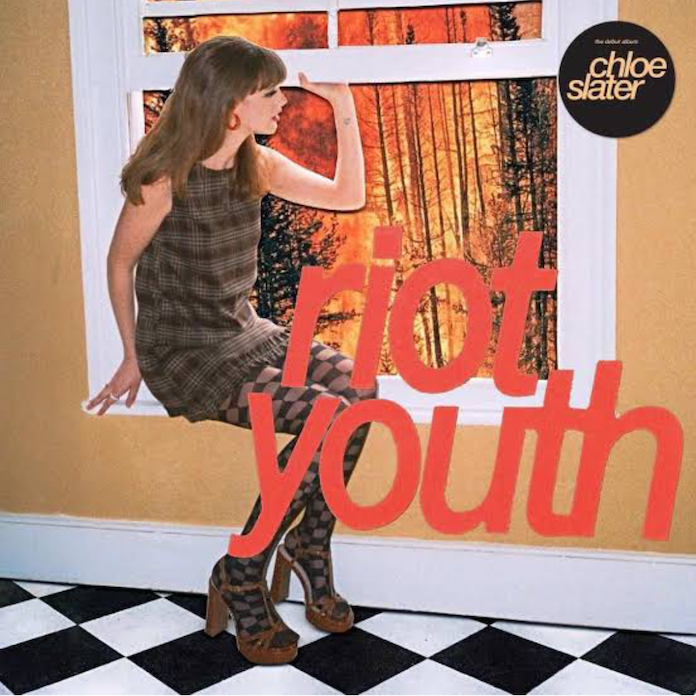
Riot Youth - Album Art

Most Recent
- 500 to Go: Join Under the Radar’s Summer Subscription Campaign (News) —
- Emma Ruth Rundle Shares New Single “Enough” (News) —
- Chloe Slater Shares New Single “Mother Nature’s Killing Spree” (News) —
- Chloe Slater: On Her Forthcoming Debut Album Riot Youth (Interview) —
- Premiere: The Braymores Share New Track “Puppy Eyes” (News) —

Comments
Submit your comment
There are no comments for this entry yet.