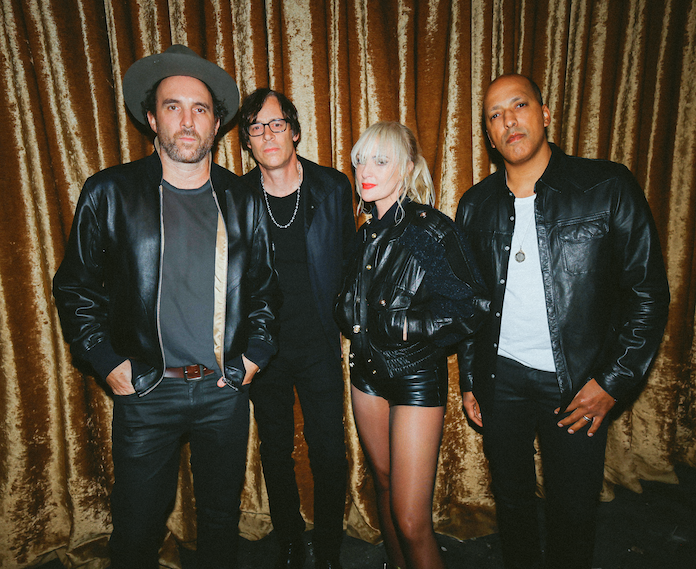
Metric on “Romanticize the Dive”
Learning to Embrace the Weirdness
Apr 22, 2026
Web Exclusive
For just over 20 years, Canadian indie outfit Metric have felt like both a comfort band and so much more than that. The brainchild of singer/songwriter Emily Haines and guitarist Jimmy Shaw, the four-piece—including Joshua Winstead (bass guitar) and Joules Scott Key (drums)—have been cranking out synth-heavy pop-punk albums since 2003. Their styles and methods have shifted, but their core sound has remained the same. Whether you’re listening to 2009’s famous Fantasies, their hit song “Black Sheep” (which you might recognize from Edgar Wright’s 2010 film, Scott Pilgrim vs. the World), or the most recent Formentera albums, Haines and co.’s sound feels modern yet nostalgic, future-facing without forgetting about the past.
With their tenth album, Romanticize the Dive, hitting record stores this Friday, Metric has a major 2026 in store. In June, they’ll be heading on tour with fellow Toronto bands (and close friends) Broken Social Scene and Stars. To speak on the album in more detail, Haines joined Under the Radar for an electric conversation, which touches on everything from the band’s songwriting process to the complex facets of nostalgia itself.
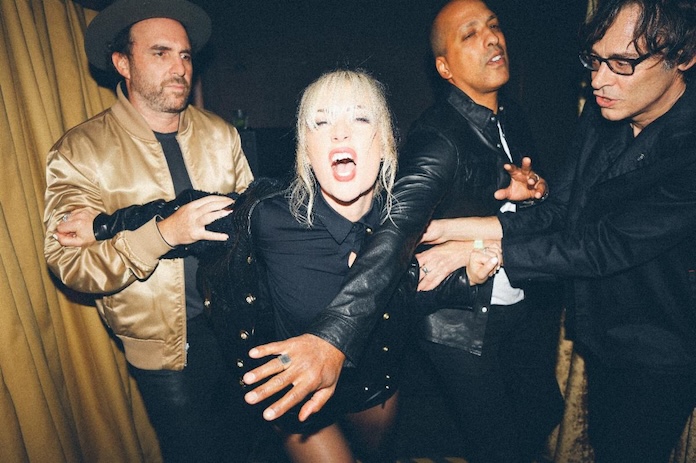
Kaveh Jalinous (Under the Radar): It feels like your last album, Formentera II, came out so recently. I was shocked to learn it’s been almost two-and-a-half years. What’s Metric been up to for these past few years?
Emily Haines (Metric): We all had our pandemic. Congratulations. We did Formentera I and II in that time. Since you’re a film guy, maybe you caught my Brazil (1985) references. I was so afraid that it was going to be so obvious, but nobody saw it. We used the font. We did the whole idea of escape to this imaginary place. “Formentera” was a real place that we made imaginary, the same way that [Terry] Gilliam made Brazil imaginary.
Anyways, there’s been lots of touring and everything around that. And then, when we started sort of regrouping on what would be [Romanticize the Dive], the anniversary [of 2009’s Fantasies] came up, and we realized it was a good time to revisit that. It was a really good setup for Romanticize the Dive, because we put back together the team that made Fantasies for this album. We went back, on a cellular level, to those songs.
We only did a few shows of Fantasies, but it was really well received and really cool to be like, “I’m proud of all of our work, but I feel there’s something about that moment that is worth seeing if we can tap back into.” I feel like we really honed our sound on that album and Synthetica, so it was cool to put the team back together.
What is that contrast like, revisiting some of your most famous songs and seeing the way that the crowd interacts with those tracks, while working on conceptualizing new ones?
It wasn’t like we were pulling things out of the archive, because the biggest songs on Fantasies are just staples of who we are. “Satellite Mind” was a cool one that we’d play occasionally as a deep cut, but we played the album in sequence. With “Satellite Mind,” we really hit that sort of slick but grimy rock, like the right leather jacket under a streetlamp, but somehow healthy.
That definitely informed us when we were working on the new material. I did a bunch of writing in Mexico City for this album; “Tremolo” was written there. When I presented it to Jimmy [Shaw], there were so many directions we could go. That’s where the [Fantasies] reference really kicked in, where it was like, “Okay, but what would this sound like if we were those people?” I feel like “Tremolo” is a little bit like “Help I’m Alive”; it’s a very unique sound, but there’s something so familiar about it. It’s sort of referential, but you’re not sure to what.
Was there a moment where you really felt that Romanticize the Dive was beginning to form, or was it more of a gradual process?
It was gradual. We took a really good approach; we’d do these short, really intensive sessions, and then we’d go away and not listen to anything. Because you have to go so micro on everything essential for the craft, there’s always a point where you’re trying to get context, and it’s the one thing that you can’t force. If you’re in the studio, and you’re like, “Hey, we got 45 minutes to have objectivity,” we don’t have objectivity, and we can’t get it. We weren’t precious about holding on. It really wasn’t until we had a lot to choose from that we started to zoom out and piece together what [the album] was.
I’m curious about the relationship to lyrics in all of this. Was your songwriting process a little bit altered for this too, as a result of that new approach?
Ultimately, I feel like I’m a musician because I’m a writer. I’m obsessed with the craft of songwriting, because it’s so weird and magical and mystical and strange and alchemy and shit. When a three-and-a-half-minute song is a prism of time and space, it’s so satisfying. We’re always bummed if anything moves longer, because we always feel like three minutes and 33 seconds is a perfect song.
I had whole things and I had statements, but a lot of what I struggle with is writing in code. “Victim of Luck” was really hard. I just couldn’t say that I was a starving artist, but I was fearless, and now all I see are my flaws and I’m kind of embarrassed. That took me a year and a half, so that was the last thing that I got.
I kind of had a jarring experience of listening back to something I wrote, where I was like, “Wow, you sound pretty poisonous.” I was pretty upset to see that mirror. Then a whole conversation ensued between Jimmy and me, where I asked him, “How have I changed? Why is my angle so cynical?” He responded, “You’re the sweetest person. When we started out, you’d see all of this hatred and poison in the world, and you’d rail against that. But where you were coming from was this place of protecting that sweetness. All this time out in the world, and some of it got in.” That was really cool to reckon with, to be like, “Okay, let’s get that out of there then.”
It’s so unique to be able to even look back, recognize the type of person you were, and see that change expressed in both a public and personal sphere.
That’s what’s also so weird about music: The transformational power of writing something, owning it, and then other people also being set free by something in there. For the record’s last song, “Leave You On a High,” I’d never had this experience before as a writer where I just flipped all the negatives to positives. It was ridiculous. The lyrics “If I could be the one to find it all, I take the gold, I’d soothe your soul.” I’ll keep it cynical, because I’m not that person. But then, “We’re not that cheap and cynical… To hold a grudge is the lowest crutch, so go big and stay high, or your mind can get so small.” That was such a crazy transformation from just saying, “Whatever.”
I love the number of paradoxes spread throughout the album’s lyrics; even the name Romanticize the Dive feels paradoxical. How did you settle on that title? And how did you know that the name was fitting to capture the album’s essence?
This is very classic for us, but the biggest song on the record we basically left off. It’s kind of like how we didn’t play “Black Sheep” for 10 years because we didn’t feel like it. The [unreleased] song is about neighborhoods being unrecognizable and missing what we had. The nostalgia piece of the album’s meaning is in that song, and the line “romanticize the dive” is in that song.
I think the album tells you this anyways: It’s a decision. I mean, it’s not a great time [right now]. And that’s been true. The factual divide between the three people who are kazillionaires and then the rest of the planet—that’s real, and we’re all feeling that. A lot of attitude around the album is, “We’re the cool people.” Just don’t forget your life, your friends, your band, the places you go to have drinks or drink coffee or whatever. You’re not an insane lunatic remaking your entire body with blood that you bought from whoever or buying up everything. Look around you. Your life’s actually cool. These places are cool. Things are gritty. It’s sexy, it’s indie sleaze. Get into it.
Of course, a 10th album is no small feat. On top of these messages, are any other meta messages about Metric that you wanted to convey as well?
I think that was the undertone here. I know neither of us are trying to be hyperbolic or dramatic, but look, are we going to make another album? I don’t know, which is not something I would have said in the past. Probably after Live It Out was the only other time that we were like, “I don’t know.” The “Leave You On a High” idea is real, and it isn’t so much about mortality necessarily. At some point you want to be like, “So, what did you stand for? So, what did you do?” You explored all these things, you experimented, but if someone has to crystallize your contribution, your statement, your energy and who you were, we knew, “This [needed] to be that.” If it all goes away for whatever reason, then we could know we got there. It does kind of make me want to cry just saying that. But that’s life.
Metric is such a global band—I know NY and LA mean a lot to you, and of course, you’re an iconic Toronto group. Have the ways in which these cities changed impacted the types of stories you want to tell?
It’s important to recognize it and speak about it, because it’s really disorienting for everyone. There’s sort of two ways that I look at it. One is that, thankfully and happily, we have a lot of new young fans, and I think that’s because we’ve always kept going. We’ve stayed connected and have seen how things have slowly changed around us. We’ve also seen this huge influence of young fans coming in and looking to us for something that they are romanticizing. Despite the cynicism we might have about stuff, this is a real thing that you should romanticize. In the same way that I was in 2003, walking around New York City, writing Old World Underground, Where Are You Now?, thinking about Lou Reed and getting to connect with him, that’s our role now. We’re not saying we’re nostalgic for this, that everything sucks now and it was better then. It’s more about how you can create this.
Again, it’s not to talk shit about the present, but being able to say, “Hey, this is what it was like.” We would play a show, and it wouldn’t matter that there were 100 people there (and that was from us being a band for over two years). The door would close, and you could do whatever you wanted. I would talk about the war, we would do crazy riffs on the songs, I would crowd surf and you were free to just relax. I’m the dorkiest dancer of all time; you can be the dorkiest dancer, and you can be drenched in sweat and be free. The All the Feelings Tour is definitely that too: Learn an instrument, have some friends, and insulate yourselves in a way that you can figure out who you are without someone filming it.

Now that you’ve mentioned All the Feelings, your tour with Broken Social Scene and Stars this summer, I wanted to note how much I love that Toronto bands stick together. I think it’s one of the coolest things about the city. And obviously you have such a history with Broken Social Scene and Stars; how are you feeling about the upcoming tour?
The fact that it’s called All the Feelings really says it all. This has been Jimmy’s dream for a decade, but the timing has never really been right. He’s the one who goes all the way back with people since he was seven years old. I met Kevin [Drew; founder of Broken Social Scene] and Amy [Millan; of Stars] when I was 15. This isn’t a casual marketing thing, and I think we’re well aware of that. Amy and me, we hang out with the kids and we don’t talk shop. We’re just civilians together and there is an element of being protective of that. That said, the timing is unbelievable, and the musical possibilities of what can happen are just really exciting. We need to band together and represent the human beings, the friendship, the things you can value, and the incredible life you can have if you pivot to recognizing what matters to you. It’s going to be imperfect, but it’s going to be human.
We’ve talked a lot about nostalgia and the past, but also a fair amount about the future. I’m curious—do you have any advice you’d give to young artists trying to navigate the endless, overwhelming nature of the current music industry?
There’s one big difference that is so monumental people almost overlook it: Distribution was impossible. That was the thing you could not get. When you have truly indie bands like Metric—where we were burning CD-Rs, having people on our email list, and mailing them CDs—we didn’t have a record deal, we couldn’t get a record deal and the record deals that we were offered were like, “Fuck this” (thank God, because we own everything). Now, distribution is the thing everybody has. I think there’s so much value and benefit from the availability that people have to our entire catalog. If it weren’t for the streaming platforms, there’s no way our entire archive of our albums would be available; they’d all be out of print. I really appreciate that part of it.
But if you’re starting out, I think it just has to be that (and maybe this will sound very of my age) you have to start out IRL and stay there. Make people meet you in the world and be in the world so they can come and find you. Position yourself there as your main location and try to simulate that distribution is literally just that. You don’t have to be in a traditional band in order to do that; even as a solo artist, I think my advice would be: Be in the world, and don’t be afraid to be weird.
[Note: This interview has been condensed and edited for clarity.]
Read our 2020 interview with Emily Haines on her favorite album.
Metric Tour Dates:
(With Broken Social Scene and Stars except where indicated)
Mon Jun 8 – Austin, TX – Moody Amphitheater
Tue Jun 9 – Dallas, TX – South Side Ballroom
Thu Jun 11 – Denver, CO – Fillmore Auditorium
Sat Jun 13 – Sandy, UT – Sandy Amphitheater
Tue Jun 16 – Los Angeles, CA – The Greek Theatre
Thu Jun 18 – Phoenix, AZ – Arizona Financial Theatre
Fri Jun 19 – San Diego, CA – Cal Coast Credit Union Open Air Theatre
Sun Jun 21 – San Francisco, CA – The Masonic **SOLD OUT
Mon Jun 22 – San Francisco, CA – The Masonic
Wed Jun 24 – Bend, OR – Hayden Homes Amphitheater
Thu Jun 25 – Seattle, WA – Chateau Ste. Michelle - NEW DATE
Fri Jun 26 – Vancouver, BC – FIFA Fan Festival **Metric Only
Fri Jul 24 – Chicago, IL – Byline Bank Aragon Ballroom
Sat Jul 25 – Detroit, MI – Fox Theatre
Mon Jul 27 – Boston, MA – MGM Music Hall at Fenway
Tue Jul 28 – Philadelphia, PA – The Met Philadelphia Presented by Highmark
Thu Jul 30 – Brooklyn, NY – Brooklyn Paramount **SOLD OUT
Fri Jul 31 – Brooklyn, NY – Brooklyn Paramount **SOLD OUT
Sat Aug 1 – Washington, DC – The Anthem
Mon Aug 3 – Atlanta, GA – Tabernacle
Tue Aug 4 – Nashville, TN – Ryman Auditorium
Fri Aug 7 – Toronto, ON – RBC Amphitheatre
Wed Sep 09 – Dublin, IE – 3 Olympia Theatre - NEW DATE
Fri Sep 11 – Glasgow, UK – O2 Academy Glasgow - NEW DATE
Sat Sep 12 – London, UK – O2 Academy Brixton - NEW DATE
Sun Sep 13 – Manchester, UK – Manchester Academy - NEW DATE
Tue Sep 15 – Paris, FR – Salle Pleyel - NEW DATE
Wed Sep 16 – Antwerp, BE – De Roma - NEW DATE
Thu Sep 17 – Utrecht, NL – TivoliVredenburg - NEW DATE
Sat Sep 19 – Berlin, DE – Columbiahalle - NEW DATE
Fri Oct 2 – St. Catharine’s, ON – Cicada Festival **Metric Only
Sat Oct 3 – London, ON – Canada Life Place - NEW DATE
Mon Oct 5 – Ottawa, ON – The Arena at TD Place - NEW DATE
Wed Oct 7 – Laval, QC – Place Bell - NEW DATE
Subscribe to Under the Radar’s print magazine.
Support Under the Radar on Patreon.

Most Recent
- 500 to Go: Join Under the Radar’s Summer Subscription Campaign (News) —
- Chloe Slater: On Her Forthcoming Debut Album Riot Youth (Interview) —
- Premiere: The Braymores Share New Track “Puppy Eyes” (News) —
- Teenage Fanclub Announce New Album, Share Video for New Song “Day in the Sun” (News) —
- Tally (Review) —

Comments
Submit your comment
There are no comments for this entry yet.