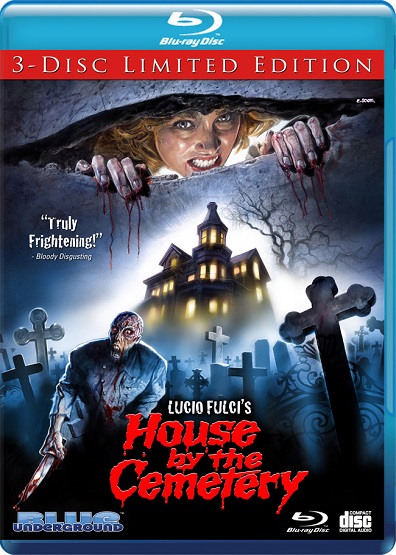
The House by the Cemetery [Limited Edition]
Studio: Blue Underground
Jan 31, 2020 Web Exclusive
Released in 1981, House by the Cemetery is regularly regarded as the third film in Lucio Fulci’s gates trilogy, following City of the Living Dead (1980) and The Beyond (1981). The first two movies are connected by gateways to other worlds, and the presence of the living dead. The black sheep of the family, House by the Cemetery features no gate to hell and only one, lonely zombie—but may be the series’ most effectively creepy film, relying on ghostly spooks as much as the director’s signature, gory spectacles.
Norman (New York Ripper’s Paola Malco) and Lucy (Catriona MacColl, who appeared in the two prior films) are a married couple from New York with a young son named Bob. After his esteemed colleague dies in a bizarre murder-suicide, Norman is asked to resume the late professor’s research at his remote, 19th Century mansion just outside of Boston. With his family accompanying him on the six-month sabbatical, they move into the spooky, old house where his predecessor murdered his mistress shortly before hanging himself. It’s bad enough that a strange, childlike sobbing can be heard from the other side of the locked basement door, but their son, Bob—obviously overdubbed by an adult woman—claims to be in contact with a ghostly little girl who repeatedly warms them to get out of the house.
Fulci’s films always forsook cohesive plots for over-the-top style, but House by the Cemetery is almost the exception. Clearly—perhaps egregiously—indebted to Kubrick’s The Shining (1980), Cemetery spends far more time exploring the history of its haunted house and its century’s worth of doomed inhabitants than its predecessors ever bothered while piecing together their “plots.” For those used to Fulci’s typical pacing—especially to those only familiar with his bonkers greatest hit, Zombie (1979)—the pacing will feel particularly slow. (Jeez, have ten whole minutes passed since we last saw a slow-motion spray of blood, or maggot-infested flesh?) As a trade-off, though, Fulci gives us a movie where the scares aren’t purely driven by the spillage of blood.
We meet the family in one of the movie’s creepiest scenes. We see a shot of the titular House, which we’re sure is located in an otherwise nice neighborhood just outside of Boston. In a close-up on the front windows, a little girl peers through curtains with wide, frightened eyes. The image slowly moves outward, until it’s obvious we’re looking at a photo. Young Bob stares at a photo hanging on the wall of his apartment, where his family is currently packing up to leave for a six-month stay in the country. Bob tells his mother that a little girl is warning him to stay away from the house; his mother, however, looks at the photo and sees no little girl, only curtains. This is super creepy – and the mother’s own surprise to discover her home for the next six months is the exact match to the random photo her son was seeing phantoms in is completely justified. It’s like the reveal of Jack Torrance’s photo at the end of The Shining, but in reverse.
While House by the Cemetery builds up some honest-to-god suspense for once, it doesn’t fail to remind you that it’s a Fulci movie. The movie opens with one of the director’s signature, random-ass scenes of unforgettable violence: an unnamed, briefly topless woman wanders through the cobwebbed corridors of an abandoned house for god knows what reason, only to stumble upon her boyfriend’s hanged and mutilated body seconds before having her skull stabbed-through with a gigantic knife that pierces her crown and bursts through her open mouth. This is the first thing we see in the movie! Of course every one of House’s kill scenes is absurdly grotesque and over-the-top. This wouldn’t be a Fulci movie if they weren’t. Even the death of a regular, old bat – which hilariously latches its teeth into our hero’s hand, and can only be removed after being stabbed with a huge knife – doesn’t pass without an incredible amount of blood dumped on the kitchen floor.
What the audience discovers early on — but our heroes obviously don’t — is that the house is haunted by the undying corpse of a mad scientist wondrously named Dr. Freudstein, who needs the fresh blood of the living at periodic intervals to continue out his sad existence deep in the basement of this drafty old estate. The movie’s finale — which involves several characters being unexpectedly trapped in the basement with the dead, mad doctor — is an exciting and sufficiently grotesque sequence, with a twist ending that’s open for interpretation.
Blue Underground’s 3-disc, limited edition of the movie includes deleted scenes, trailers, and marketing materials, plus interviews with everyone but Fulci who was involved in the film’s making. New to this edition are a Q&A with star Catriona MacColl and pre-eminent Fulci scholar Stephen Thrower, who also provides a feature-length commentary. Best of all (that is, besides the movie’s lenticular, throwback slipcover) is the third disc: a CD which includes the movie’s full score by Walter Rizzati. This release should be an auto-pickup for Fulci fans, particularly those who had written it off as one of the director’s lesser works – the bonus materials included here support the argument that it’s a movie ripe for re-appraisal.
(www.blue-underground.com/product.php?product=298)

Most Recent
- Social Distortion Share Video for New Single “Tonight” (News) —
- Confidence Man Share New Single “Young London” (News) —
- Vivian Girls @ Elsewhere (The Rooftop), Brooklyn, New York, US, July 8, 2026 (Review) —
- Nottingham Waterfront Festival 2026, The Canalhouse, Nottingham, UK, July 4, 2026 (Review) —
- Sammy Hagar @ British Airways ARC, London, UK, July 9, 2026 (Review) —

Comments
Submit your comment
There are no comments for this entry yet.